Pakistan’s venture capital landscape brings together independent investment teams, locally managed funds and partnerships linking domestic businesses with international capital. Their investment strategies cover companies digitizing payments, commerce and logistics, alongside technology businesses building products for customers beyond Pakistan.
This mapping profiles eight active venture capital investors with Pakistan as their primary ecosystem. It examines their investment focus, portfolio companies and operating structures, drawing on research completed on October 27, 2026.
What the mapping reveals
Early-stage investing anchors the landscape
Several of the mapped investors concentrate on the first stages of company building. Indus Valley Capital often invests among a startup’s earliest backers, i2i Ventures focuses on pre-seed and seed businesses, and Zayn VC backs early-stage technology companies. Their portfolios include financial services, commerce and logistics businesses addressing gaps in Pakistan’s economy.
The range extends beyond seed funding. Lakson Venture Capital’s mandate includes early and growth-stage opportunities, while sAi Venture Capital’s current strategy emphasizes growth equity and frontier technologies. For founders, the relevant distinction is the stage and business model a fund supports, alongside its connection to the local ecosystem.
Pakistan is both a customer market and a base for global businesses
Other strategies build on Pakistan’s technical capabilities and founder networks to serve customers internationally. sAi focuses on technology businesses targeting global enterprise clients, supporting portfolio companies as they develop products and expand into overseas markets. COLABS provides a concrete example of cross-border portfolio growth: in April 2026, the Pakistan-founded workspace business launched a 4,000-square-meter campus in northern Riyadh. Its announcement identified Fatima Gobi Ventures, Indus Valley Capital and Zayn VC among its existing investors, connecting three of the mapped firms to the company’s international expansion. These examples illustrate how a Pakistan-centered investment ecosystem can support both domestic market development and businesses serving customers abroad.
Dedicated funds operate through different institutional structures
The mapped landscape includes independent teams alongside fund managers connected to larger business groups. Fatima Gobi Ventures combines Fatima Group’s local experience with Gobi Partners’ regional network and manages Techxila Fund I, which has received backing from British International Investment. Lakson’s venture business sits within an established investment manager operating across several asset classes. IJARA Capital Partners’ 2026 technology fund launch with S2 adds another collaboration between an established investment manager and a technology partner.
Fund cycles also differ. i2i Ventures described its June 2026 investment in Revora as the final new investment from Fund I, while discussing its ambitions for Fund II. A firm can remain active through portfolio management and preparation for its next fund after completing a vehicle’s new investments. Current operations and immediate capacity to finance a new company therefore require separate assessment.
The venture capital investors
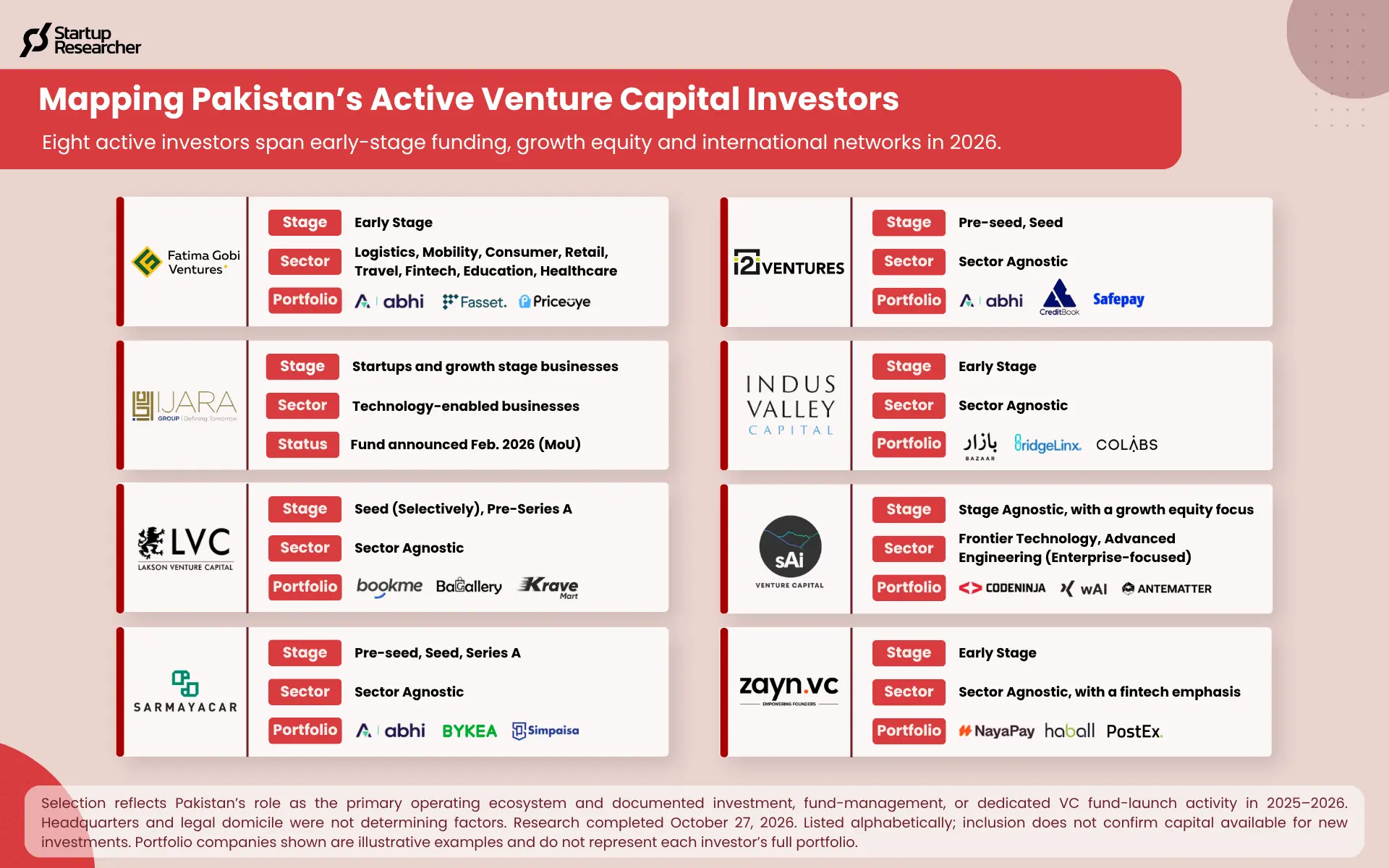
Fatima Gobi Ventures
Fatima Gobi Ventures is a Pakistan-focused venture capital fund manager combining Fatima Group’s domestic market experience with Gobi Partners’ regional investment network. General Partner Ali Mukhtar and Partner Naiel Ikram are among its Pakistan-based leadership. Its strategy covers the digitization of traditional industries and access to services across fintech, logistics, commerce, education and healthcare, with portfolio companies including ABHI, PriceOye, Maqsad, Rider, AdalFi, Qist Bazaar and Fasset. The firm manages Techxila Fund I, which has received backing from British International Investment. In February 2026, Gobi Partners outlined plans for Techxila Fund II, a proposed US$50 million vehicle it intends to anchor with its own capital while seeking backing from domestic and international institutional investors. Fatima Gobi first backed Fasset in 2022, co-leading its US$22 million Series A alongside Liberty City Ventures. In August 2026, Fasset announced a US$68 million Series C led by SBI Group at a US$1 billion valuation, marking a unicorn milestone for the portfolio company rather than a realized investment return for Fatima Gobi.
i2i Ventures
Launched in August 2019 by Kalsoom Lakhani and Misbah Naqvi, i2i Ventures is a standalone venture capital fund investing in pre-seed and seed-stage technology businesses. Its Pakistan-centered portfolio includes CreditBook, ABHI, Safepay, DealCart and Oraan, spanning financial services, commerce and other parts of the digital economy. The firm supports founders with fundraising, strategy, hiring and access to experienced operators. In June 2026, it co-led Revora’s US$2 million seed round with Oraseya Capital, backing an AI commerce business serving international markets. i2i described the transaction as Fund I’s final new investment and discussed its plans for a second fund.
IJARA Capital Partners
IJARA Capital Partners is a Karachi-based private equity and venture capital manager led by CEO Farrukh Naseem Ansari. In February 2026, it announced a PKR 1 billion closed-end venture capital fund in collaboration with S2, focused on high-growth, technology-enabled enterprises within and beyond Pakistan. The partnership was formalized through a memorandum of understanding, with S2 named as the technical and strategic partner, bringing technology expertise, operational insight, and initial capital. The announcement did not confirm a completed fund close or initial investments. The proposed fund adds a dedicated technology initiative to IJARA’s broader investment business, which includes healthcare, pharmaceuticals and other established sectors. The collaboration was unveiled at S2 CONNECT 2.0 in Karachi and Islamabad.
Indus Valley Capital
Founded by former LinkedIn executive Aatif Awan, Indus Valley Capital is an early-stage venture capital firm backing Pakistani founders across sectors. It often invests at the beginning of a company’s development and supports founders through product and growth expertise and introductions to other investors. Its published portfolio includes Bazaar, BridgeLinx, Markaz and Uplift AI, reflecting interests in commerce, logistics and artificial intelligence. In January 2026, the firm led Uplift AI’s US$3.5 million seed round alongside Y Combinator. The investment supports voice technology for languages underserved by major AI providers, adding an AI infrastructure business to the firm’s broader portfolio.
Lakson Venture Capital
Lakson Venture Capital is the dedicated venture investment business managed by Lakson Investments, whose CEO is Babar Ali Lakhani. Its mandate covers Pakistan-based technology opportunities at early and growth stages, including selected seed investments. It backs businesses using technology to improve existing industries or develop new business models, drawing on the manager’s investment expertise and the wider Lakson Group’s operating relationships. Its investments include Bookme, Bagallery and Krave Mart, spanning ticketing, beauty and fashion commerce, and grocery delivery. In March 2026, inDrive confirmed its acquisition of Krave Mart in a reported all-stock transaction. PACRA’s August 24, 2026 assessment of Lakson Investments described a diversified venture capital portfolio and a sustainable fund size. The assessment supports continuing fund operations, while the acquisition represents a portfolio development rather than a new Lakson investment.
sAi Venture Capital
Founded in 2022 and based in Lahore, sAi Venture Capital is led by Founder and Managing Partner Ahsan Jamil. Its current strategy emphasizes growth equity and frontier technologies serving large international enterprise customers, combining investment with operational guidance and commercial networks. On April 29, 2025, it signed an agreement with the Pakistan Software Houses Association (P@SHA) to mobilize and raise up to US$100 million for member companies, supporting Pakistani technology businesses seeking to expand internationally. The figure represents an investment-mobilization target, not a completed fundraise or capital already deployed. Its investments include enterprise AI company wAI Industries, for which sAi announced a US$1.5 million follow-on investment as part of a wider US$10 million growth round structured in two tranches, with the second tied to agreed milestones. Its advisory appointments in 2026 further reflect its focus on helping portfolio companies sell to international business customers.
Sarmayacar
Sarmayacar is a Pakistan-focused venture capital firm founded by Rabeel Warraich, who serves as CEO. It developed from an angel syndicate into an institutional venture fund in 2018 and backs technology businesses across sectors including financial services, mobility, logistics, gaming and hospitality. Its published portfolio includes Bykea, ABHI, Simpaisa, Procheck and Revolving Games. The firm also supports companies expanding beyond Pakistan. In December 2025, Warraich described its Saudi expansion as a way to help Pakistani businesses enter the market while drawing on Pakistan’s product development and engineering capabilities, connecting its domestic investment experience with a wider regional strategy.
Zayn VC
Founded by Faisal Aftab in 2021, Zayn VC is an Islamabad-based firm investing in early-stage technology companies in Pakistan. Its strategy spans sectors, with a particular emphasis on fintech, and its published portfolio includes NayaPay, Haball, PostEx, Bookme, EduFi and LAAM. These investments cover payments, business finance, logistics, travel and commerce. The firm operates through offshore fund structures while maintaining Pakistan as its core investment ecosystem. In April 2025, Zayn VC led the US$5 million equity component of Haball’s US$52 million financing, providing direct evidence of recent investment activity. Its portfolio company Krave Mart was subsequently acquired by inDrive in 2026.
Methodology
This mapping covers venture capital investors with Pakistan as their primary operating ecosystem, including specialist VC firms, dedicated venture investment businesses and broader fund managers with a distinct venture capital strategy. Headquarters and legal domicile were not determining factors. Pakistan’s role in the organization’s team, founder network and investment activity was considered. An exclusive Pakistan investment mandate was not required. International investors whose connection to Pakistan was limited to occasional portfolio investments were excluded.
Research was completed on October 27, 2026. Official fund websites, investment announcements, leadership statements, regulatory information, institutional disclosures and independent fund-management assessments were prioritized, with investment databases and reputable media used as supporting sources.
Inclusion required credible evidence of venture investment, fund-management activity or the launch of a dedicated venture capital fund during 2025 or 2026. Completed investments, portfolio activity demonstrating the manager’s continued involvement, recent assessments of operating funds and official fund-launch announcements were considered alongside direct statements from fund leadership. Newly launched funds could qualify without a disclosed first investment, and announced fund sizes were distinguished from completed fundraising closes. Database status labels, live websites and directory profiles were not sufficient on their own.
Corporate venture capital arms, angel syndicates, accelerators, incubators, venture studios, general investment platforms and private equity-only firms were excluded. A distinct institutional venture fund could qualify within a wider investment management or corporate-backed structure where its dedicated fund-management business was established. Historical investors without sufficient evidence of current operations were excluded.
Related brands, parent companies and affiliated vehicles were reviewed to avoid double-counting. The entries are presented alphabetically, with no ranking of investment performance, capital available or willingness to consider new investments.
The eight investors illustrate several routes through which Pakistan’s technology businesses can access capital, from first institutional checks to growth investment and international expansion. Their portfolios connect the digitization of domestic industries with the development of products for customers abroad.
For founders, the practical next step is to assess fit at the fund level: investment stage, sector priorities, geographic mandate and position in the fund cycle. Those factors determine whether an investor’s experience and available capital match the company’s next phase of development.