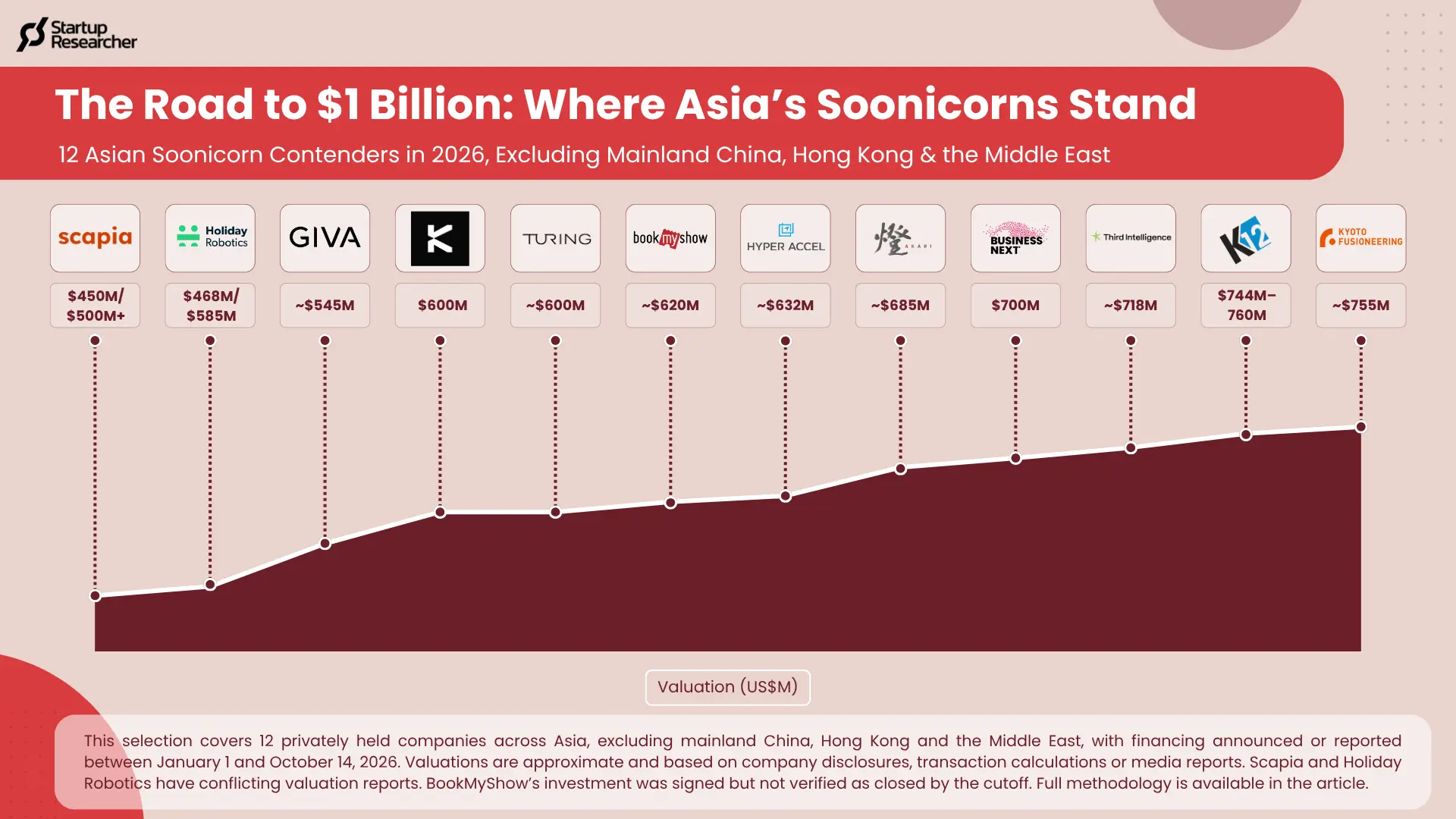
As of October 14, 2026, twelve privately held companies across selected Asian ecosystems form this selection of potential soonicorns, supported by financing announcements and company-disclosed or media-reported valuations of at least US$500 million and below US$1 billion. India contributes five companies, followed by Japan with four, South Korea with two and Singapore with one. Their businesses span artificial intelligence, financial services, consumer commerce, education, autonomous driving, robotics, semiconductors, fusion engineering and live entertainment.
The selection includes three qualifications that affect how it should be read. Scapia and Holiday Robotics have conflicting reported valuations, including figures below the inclusion threshold. BookMyShow’s investment was announced through signed definitive agreements, with closing unverified by the cutoff.
India’s Sector Diversity Meets Japan and South Korea’s Technology Focus
India Leads the Selection While Japan and South Korea Concentrate on Advanced Technology
India accounts for five of the twelve companies, or 41.7%, with representation across five broad sectors. GIVA operates in jewelry retail, Scapia combines travel and financial services, K12 Techno Services provides education services, BUSINESSNEXT develops banking software, and BookMyShow operates in ticketing and live entertainment. This breadth brings consumer platforms and established service providers into the same selection as technology developers.
Japan and South Korea together contribute six companies, representing half the selection. Japan’s businesses span industrial AI, adaptive intelligence, autonomous driving and fusion engineering, while South Korea contributes humanoid robotics and AI semiconductors. Singapore’s KAST adds stablecoin-based financial services. These patterns describe the companies identified under this article’s criteria rather than the overall distribution of investment across the region.
Younger Companies Share the Spotlight With Established Businesses
Seven of the twelve companies were founded in 2021 or later: AKARI, Third Intelligence, KAST, Scapia, Turing, Holiday Robotics and HyperAccel. Their presence shows how relatively young businesses can attract substantial valuations, particularly where investors are backing technology development and future commercialization.
The selection also includes businesses with considerably longer operating histories. BUSINESSNEXT was founded in 2002, while BookMyShow’s parent, Bigtree Entertainment, dates to 1999; the BookMyShow platform launched in 2007. K12 Techno Services, founded in 2010, provides another example of an established private company within the valuation range.
Third-Quarter Announcements Account for More Than Half the Selection
Seven qualifying announcements or financing reports fall in the third quarter, compared with four in the first quarter and one in the second. July contributes four companies across autonomous driving, education, humanoid robotics and banking software. BookMyShow and Kyoto Fusioneering follow in August, with HyperAccel in September.
The transactions also differ in structure. They include primary equity rounds, combinations of equity and debt, primary-plus-secondary investments and a signed minority investment whose completion had not been verified by the cutoff. These differences matter when interpreting how much capital reached a company and whether an announced transaction had closed.
Asia’s 2026 Soonicorn Contenders
Scapia
Established in 2022, Scapia combines travel bookings, credit card products and digital payments. In May 2026, it raised US$63 million in financing led by General Catalyst, with participation from existing investors Peak XV Partners and Z47. TechCrunch reported a post-money valuation above US$500 million. Moneycontrol separately reported approximately US$450 million for the same financing. Scapia is therefore retained as a qualified entry: its inclusion depends on the higher report, and the discrepancy remains unresolved.
Holiday Robotics
Founded in 2024, Holiday Robotics develops industrial humanoid robots, including its FRIDAY platform. The company announced completion of a ₩155 billion Series A, approximately US$103M, on July 13, 2026. SmartToday calculated a post-money valuation of approximately ₩879.3 billion, equivalent to US$585M, using the reported share issuance and total share count.
The Bell and DealSite reported approximately ₩700 billion post-money, equivalent to US$466M. DealSite’s subsequent reporting also distinguished the completed transaction’s lower valuation from previously circulated expectations. Holiday Robotics’ inclusion consequently remains disputed and depends on SmartToday’s calculation; the conflicting reports place it on opposite sides of the article’s US$500 million threshold.
GIVA
Founded in 2019, GIVA operates an omnichannel jewelry business offering silver, gold and lab-grown diamond products. Its February 2026 Series C extension raised approximately ₹110 crore, or US$12M, led by HPV CC1, with participation from Premji Invest, Kenro Capital and Titan Capital. Entrackr estimated that the financing valued GIVA at approximately ₹4,900 crore, or US$545M. Although the initial report described an approved share issuance, subsequent coverage confirmed that the February extension had been raised.
KAST
Launched in 2024, KAST provides financial accounts, payments and spending products built around stablecoin infrastructure. On March 9, 2026, it announced an US$80 million Series A co-led by QED Investors and Left Lane Capital. Bloomberg reported that the financing valued the company at US$600 million, citing people familiar with the transaction. The funding supports international expansion, hiring, licensing and product development as KAST expands its digital-dollar financial services.
Turing
Founded in 2021, Turing develops AI technology for autonomous driving. On July 6, 2026, it announced a US$79 million Series A extension comprising US$43 million in equity and a US$36 million loan facility with MUFG Bank. The extension brought the overall Series A to US$174 million, including financing announced in November 2025. Bloomberg’s reporting placed Turing’s valuation at approximately US$600 million. The financing supports development of its autonomous-driving systems and computing infrastructure.
BookMyShow
BookMyShow operates a ticketing and live-entertainment platform launched in 2007 by Bigtree Entertainment, which was founded in 1999. On August 19, 2026, KKR and BookMyShow announced signed definitive agreements for a minority investment. The Economic Times reported approximately US$40 million in primary capital at a valuation of around US$620 million.
The investment is intended to support BookMyShow’s live-entertainment business and wider entertainment offering. The announcement made the transaction subject to regulatory approvals, and closing had not been verified by October 14. BookMyShow is included on the basis of a signed agreement, with the reported terms distinguished from a completed investment.
HyperAccel
Founded in 2023, HyperAccel develops AI semiconductor accelerators optimized for large language model inference. By September 14, 2026, HyperAccel had raised ₩150 billion, approximately US$111M, through the second close of its Series B. Hankyung reported a valuation of approximately ₩850 billion for the round, equivalent to US$632M, while a September 14 Edaily interview confirmed completion of the second close. The company was seeking additional capital toward a total round of up to ₩200 billion; that target is separate from the amount already raised.
AKARI
Founded in 2021, AKARI develops AI technology for industries including construction, manufacturing and logistics. On January 29, 2026, the company announced a ¥5 billion investment from Mitsubishi Electric, completed the previous day, at a disclosed pre-money valuation of ¥100 billion. Adding the new equity implies a post-money valuation of ¥105 billion, approximately US$685M. The investment supports research, development and business expansion, alongside a strategic partnership focused on applying AI to industrial operations.
BUSINESSNEXT
Established in 2002, BUSINESSNEXT develops customer relationship management and AI-enabled software for banks and other financial institutions. In July 2026, it raised US$40 million in a Series C investment from ServiceNow Ventures at a US$700 million valuation, according to Business Standard. The companies also announced a strategic partnership focused on AI-based financial services across Asia-Pacific. BUSINESSNEXT plans to use the investment for research and development, expansion into additional markets and its private AI capabilities.
Third Intelligence
Established in 2025, Third Intelligence develops AI systems designed to learn and adapt to individual users. On January 29, 2026, it announced an additional ¥2 billion equity investment from Sumitomo Mitsui Trust Bank and a Shizuoka Financial Group-affiliated fund. This brought its initial funding round to ¥10 billion, including ¥8 billion announced in November 2025. Nikkei reported an estimated valuation of ¥110 billion, approximately US$718M, following the additional financing. The valuation is a media estimate rather than a company-disclosed price.
K12 Techno Services
Founded in 2010, K12 Techno Services provides school management, educational content and technology services through businesses including Orchids The International School and Eduvate. In July 2026, Vitruvian Partners invested approximately ₹1,159 crore, or US$122M, in a transaction that Mint reported valued K12 at ₹7,100–7,250 crore post-money, approximately US$744–760M. Around ₹150 crore, or US$16M, represented primary capital, with the remainder comprising secondary share purchases. The transaction therefore combined new company funding with liquidity for existing shareholders.
Kyoto Fusioneering
Established in 2019, Kyoto Fusioneering develops engineering systems required for commercial fusion energy, including plasma heating, fuel-cycle and thermal-management technologies. On August 24, 2026, it announced the first close of its Series D, securing ¥16.72 billion in equity, approximately US$105M, alongside access to ¥9 billion in credit and loan facilities, approximately US$57M.
Industry publication CINIE reported a valuation of approximately ¥120 billion following the financing, equivalent to around US$755M using the exchange rate provided in the company’s announcement. The funding supports demonstration projects, manufacturing capacity and international operations. The financing figures are company-announced, while the valuation is media-reported.
Methodology
This article examines financing activity announced or reported between January 1 and October 14, 2026, involving independently founded, privately held companies in selected Asian ecosystems. The target valuation range is at least US$500 million and below US$1 billion, supported by evidence tied to the qualifying transaction. Inclusion does not imply that a company first entered this valuation range in 2026 or will subsequently become a unicorn.
Geographic eligibility is determined by the company’s primary ecosystem rather than incorporation alone. Mainland China, Hong Kong, the Middle East, Australia and New Zealand are outside the scope. Companies that previously reached unicorn status or initiated a formal IPO process by the cutoff are excluded. Formal IPO steps include underwriter selection or appointment and regulatory filings; general statements of future listing ambitions are insufficient on their own.
Qualifying transactions may include primary equity, mixed equity-and-debt financing, primary-plus-secondary investments and secondary-only transactions. Completed interim closes are eligible even when a larger round remains open. Signed definitive agreements may also qualify, with pending completion explicitly identified. Negotiations, proposed investments and unraised fundraising targets are excluded. Debt financing cannot establish eligibility by carrying forward an unrelated historical valuation.
Valuation evidence comes from company and investor announcements or media reporting. Database valuation estimates are excluded, including when repeated by news outlets. A publication’s own transaction-based calculations and straightforward arithmetic from disclosed terms are permitted and labeled. Company-disclosed prices, media estimates and disputed reports are distinguished throughout. Scapia and Holiday Robotics remain qualified entries because their competing reports cross the inclusion threshold.
Dollar equivalents are approximate. Company or media conversions are retained where provided. Additional conversions use contemporaneous reported exchange rates: ¥153.28 per US dollar for the January Japanese announcements, ₹95.3875 for K12, ₩1,503.4 for Holiday Robotics and ₩1,345.9 for HyperAccel. Kyoto Fusioneering’s conversion uses the ¥159 rate supplied in its announcement.
The twelve companies bring together consumer platforms, established service providers and businesses developing advanced technologies. India has the largest individual representation, while Japan and South Korea together account for half the selection.
Their financing activity also shows the importance of reading valuations alongside transaction structure and status. New equity, loans, secondary purchases and signed agreements serve different purposes, while conflicting valuation reports can determine whether a company falls within the soonicorn range.