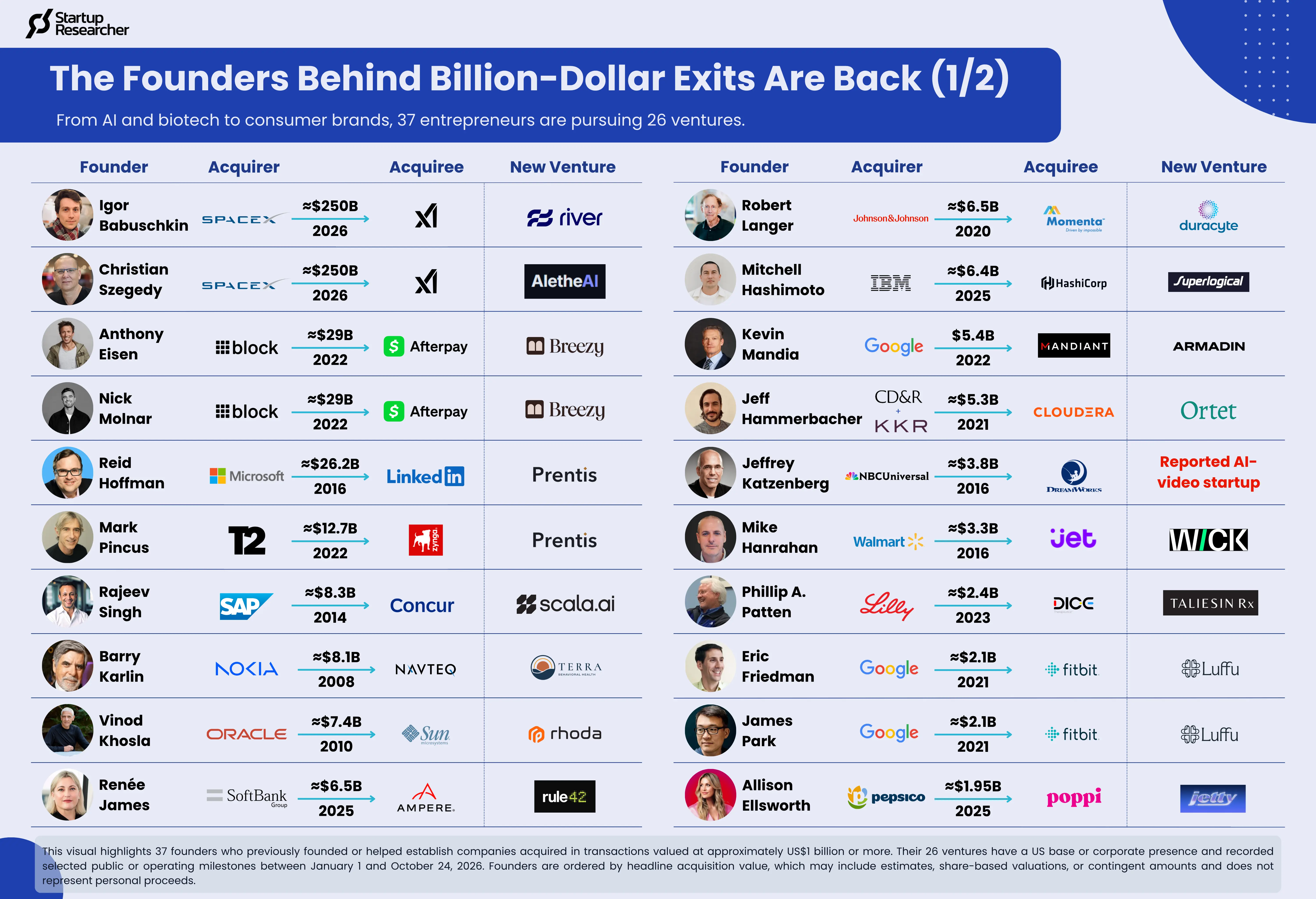
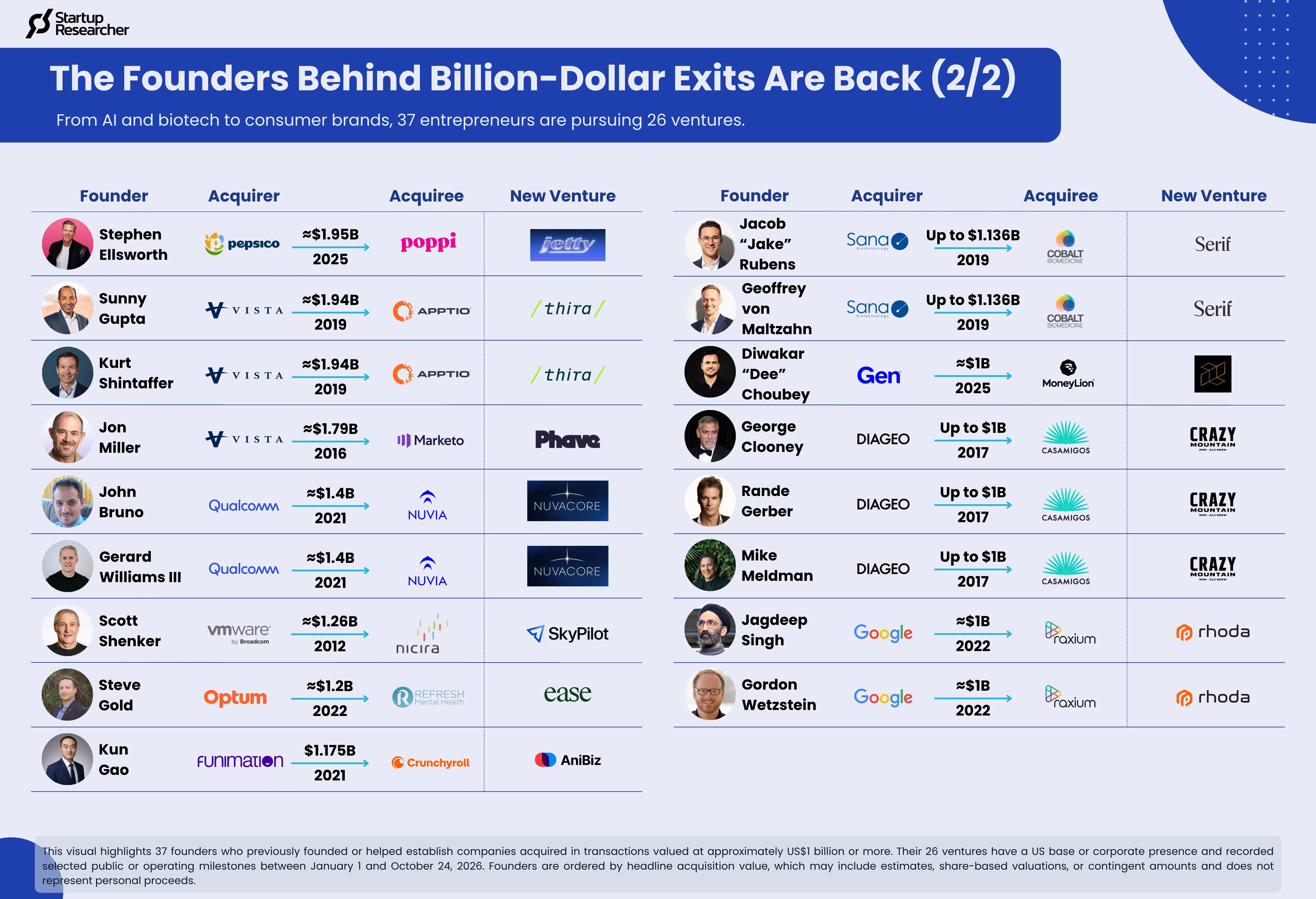
A major acquisition can represent the culmination of years of entrepreneurship, but many founders subsequently pursue another company. This mapping profiles 37 founders associated with 26 ventures with a US base or corporate presence that recorded selected public or operating milestones between January 1 and October 24, 2026. Each founder previously founded or helped establish a company acquired in a transaction valued at approximately US$1 billion or more. Their ventures span artificial intelligence, biotechnology, cybersecurity, financial technology, consumer products, and other sectors, reflecting both continued specialization and moves into new markets.
The Second Act, Long Gaps, Familiar Teams, and New Markets
A Six-Year Average Gap to the Selected 2026 Milestones
Across the 37 founder profiles, the average calendar-year difference between the acquisition profiled and the venture's selected 2026 milestone was approximately six years, with a median of five years. In 22 cases, representing approximately 59.5% of the total, at least five calendar years separated the acquisition year from 2026. The longest interval was 18 calendar years for Barry Karlin, whose earlier company NAVTEQ was acquired by Nokia in 2008, while Igor Babuschkin and Christian Szegedy were associated with new AI ventures publicly introduced or identified in the same year SpaceX acquired xAI. These comparisons describe the selected transactions and milestones, rather than the time founders waited before establishing another business.
Eight Ventures Reunited Founders From Earlier Acquisitions
Nine of the 26 ventures involved at least two profiled entrepreneurs with previous qualifying acquisition histories, and eight reunited founders who had helped build the same earlier company. These partnerships include George Clooney, Rande Gerber, and Mike Meldman moving from Casamigos to Crazy Mountain, Sunny Gupta and Kurt Shintaffer establishing Thira after Apptio, and Nick Molnar and Anthony Eisen building Breezy after Afterpay. The pattern also extends to biotechnology, with Geoffrey von Maltzahn and Jake Rubens moving from Cobalt Biomedicine to Serif Biomedicines, showing how established working relationships can carry into another generation of companies.
Founders Returned to Familiar Industries and Entered New Markets
Some founders applied their experience to closely related markets, including Phillip Patten moving from DICE Therapeutics to Taliesin Rx and Scott Shenker returning to infrastructure software with SkyPilot after Nicira. Barry Karlin likewise returned to behavioral healthcare with Terra after previously founding CRC Health Group. Other ventures crossed clearer industry boundaries, with Renée James shifting from processors at Ampere Computing to sports technology at Rule42 and Afterpay's Nick Molnar and Anthony Eisen entering real estate software with Breezy.
The Founders Behind the Ventures
Igor Babuschkin
Igor Babuschkin co-founded xAI in 2023 after working on machine learning research and large-scale AI systems at DeepMind and OpenAI. SpaceX acquired xAI in February 2026 through a share-based transaction that reportedly assigned approximately US$250 billion in implied equity value to the AI company. On June 10, 2026, Babuschkin launched River AI, a startup developing AI models and infrastructure designed to let individuals and organizations personalize, train, and control intelligent systems.
Christian Szegedy
Christian Szegedy was another member of xAI's founding team, but his subsequent venture took a different direction from Babuschkin's River AI. He co-founded AletheAI with theoretical physicist Michael R. Douglas to pursue AI-assisted mathematical reasoning, formal verification, and scientific discovery. Szegedy was publicly associated with AletheAI by March 9, 2026, and the company established a distinct US corporate presence that year, although its operational headquarters and formal launch date remain unverified.
Anthony Eisen
Anthony Eisen co-founded Afterpay with Nick Molnar before Block acquired the buy-now-pay-later company in January 2022 under an agreement initially valued at approximately US$29 billion. The two reunited in 2024 to establish Breezy, moving into software for residential real estate professionals. Breezy officially launched on February 2, 2026, with US$10 million in pre-seed financing and AI tools for managing clients, preparing property comparisons, and automating administrative work.
Nick Molnar
Molnar's involvement in Breezy extends his partnership with Eisen, with whom he also served as Afterpay's co-CEO. Their new founding team includes real estate agent James Harris and the Khalili Brothers, combining the Afterpay founders' technology background with property and venture capital experience. Before its public debut, more than 200 real estate agents helped shape Breezy around the practical demands of their work.
Reid Hoffman
Reid Hoffman co-founded LinkedIn, which Microsoft acquired for approximately US$26.2 billion in December 2016. He also co-founded Prentis alongside Zynga founder Mark Pincus and entrepreneur Ritankar Das. Launched in April 2026, the AI research company develops models that can operate software applications and carry out business workflows.
Mark Pincus
Pincus co-founded Prentis with Hoffman and Das after building Zynga, the gaming business behind titles including FarmVille and Words With Friends. Take-Two Interactive completed its acquisition of Zynga in May 2022 under a cash-and-stock agreement initially valued at approximately US$12.7 billion in enterprise value.
Rajeev Singh
Rajeev Singh co-founded Concur, the travel and expense software company SAP acquired for approximately US$8.3 billion in 2014. He publicly identified himself as Scala's co-founder and executive chairman in 2025, ahead of the company's official emergence from stealth on February 11, 2026. Scala develops operational intelligence software for contact centers, helping operators coordinate human employees, AI systems, and business processes.
Barry Karlin
Barry Karlin co-founded Karlin & Collins with Galen Collins in 1985; the digital mapping company later became NAVTEQ, which Nokia acquired for approximately US$8.1 billion in 2008. He also founded CRC Health Group, a behavioral healthcare provider later acquired by Acadia Healthcare. Karlin is now founder and executive chairman of Terra Behavioral Health, which was founded in 2025 and opened its first residential facility in Temecula, California, in March 2026.
Vinod Khosla
Vinod Khosla co-founded Sun Microsystems in 1982, and Oracle acquired the computing company in 2010 in a transaction initially announced at approximately US$7.4 billion. At Rhoda AI, he joined a founding team that includes Jagdeep Singh and Gordon Wetzstein, taking a personal co-founder role alongside his firm's investment in the business. Rhoda emerged from stealth on March 10, 2026, with US$450 million in Series A funding to develop AI systems that enable robots to work in changing industrial environments.
Renée James
Renée James founded Ampere Computing, a semiconductor company developing energy-efficient processors for cloud and enterprise computing that SoftBank acquired in November 2025 for approximately US$6.5 billion. Her next venture, Rule42 Sports Technology Group, develops an AI-powered platform helping amateur athletes become discoverable to college recruiters, scouts, and teams. Rule42 officially launched on August 4, 2026, with an initial focus on baseball and softball, although conflicting professional records leave its exact formation chronology unresolved.
Robert Langer
Robert Langer co-founded Momenta Pharmaceuticals, which Johnson & Johnson acquired for approximately US$6.5 billion in October 2020. He is also a co-founder of Duracyte, a Houston biotechnology company developing implantable biohybrid devices designed to continuously produce therapeutic proteins inside the body. Duracyte was publicly named among Rice University's incubated companies in June 2024, ahead of its formal launch on April 15, 2026.
Mitchell Hashimoto
Mitchell Hashimoto co-founded HashiCorp, helping develop infrastructure software tools including Terraform and Vagrant that became widely adopted components of modern cloud engineering. IBM completed its approximately US$6.4 billion acquisition of HashiCorp in February 2025, expanding its capabilities in infrastructure automation and hybrid cloud management. On July 29, 2026, Hashimoto announced the launch of Superlogical, a new developer tools company initially focused on building a terminal multiplexer and improving how programmers interact with computing environments.
Kevin Mandia
Kevin Mandia co-founded Mandiant, establishing a cybersecurity company recognized for investigating sophisticated cyberattacks, responding to security incidents, and providing threat intelligence to major organizations. Google completed its US$5.4 billion acquisition of Mandiant in September 2022, integrating the business into Google Cloud's security operations. On March 10, 2026, Mandia launched Armadin, a cybersecurity startup developing autonomous AI agents that simulate sophisticated attacks to identify exploitable weaknesses before malicious actors can take advantage of them.
Jeff Hammerbacher
Jeff Hammerbacher co-founded Cloudera, helping develop an enterprise data infrastructure business focused on large-scale information processing, analytics, and data management. Cloudera was taken private in October 2021 through an approximately US$5.3 billion acquisition by affiliates of Clayton, Dubilier & Rice and KKR. On September 29, 2026, Hammerbacher launched Ortet, an AI research company focused on healthcare applications, backed by an announced US$500 million commitment from Thoreau to support the development of more individualized medical technologies.
Jeffrey Katzenberg
Jeffrey Katzenberg co-founded DreamWorks Animation, which NBCUniversal acquired in August 2016 for approximately US$3.8 billion. His next reported venture is an unnamed AI-video startup with former OpenAI Sora research leader Bill Peebles and investor Sujay Jaswa, first reported on September 9, 2026. October 12 reporting described the trio as co-founders and said the startup was discussing access to Sora, with no agreement or formal public launch confirmed.
Mike Hanrahan
Mike Hanrahan co-founded Jet.com, an e-commerce startup that Walmart acquired for approximately US$3.3 billion in 2016. As its chief technology officer, he helped build the marketplace's technology and pricing infrastructure. By September 2026, Hanrahan was publicly identified as founder and CEO of Wick, a New York-based company developing an algorithmic investing platform with tax-aware portfolio management for individual investors.
Phillip A. Patten
Phillip A. Patten co-founded DICE Therapeutics, a biotechnology company developing oral medicines for immunological diseases that Eli Lilly acquired in August 2023 for approximately US$2.4 billion. In November 2025, Patten began serving as founder and CEO of Taliesin Rx, an independent biotechnology startup based in Redwood City, California, focused on discovering cardiac-selective medicines for cardiovascular diseases. Taliesin Rx was publicly identifiable during 2026, although a specific formal public launch date has not been established.
Eric Friedman
Eric Friedman co-founded Fitbit and served as its chief technology officer before Google completed its approximately US$2.1 billion acquisition in January 2021. He reunited with James Park on February 3, 2026, to introduce Luffu, which is developing AI tools to organize family health information and coordinate care. Friedman has described the challenge in terms of his own household, where caregiving spans children, parents, and a father in his 80s living with diabetes.
James Park
Park's decision to co-found Luffu with Friedman was shaped by his experience caring for his parents from across the country. The Fitbit co-founder and former CEO described struggling to connect information across providers and medical portals, with a language barrier further complicating conversations about his mother's care. Those difficulties helped shape Luffu's focus on giving caregivers a shared view of their family's health.
Allison Ellsworth
Allison Ellsworth co-founded Poppi with Stephen Ellsworth before PepsiCo acquired the brand in May 2025 for approximately US$1.95 billion in gross consideration, or US$1.65 billion after anticipated tax benefits, plus a performance-based earnout. On October 13, 2026, she unveiled Jetty, a new consumer brand being built with Stephen. Its commercial launch is scheduled for November 9, while the founders have kept the product undisclosed.
Stephen Ellsworth
Stephen Ellsworth is again building alongside Allison, extending the husband-and-wife partnership behind Poppi. By August 2026, the pair were recruiting for their next consumer products company, which already had seven employees. That hiring effort preceded Jetty's named reveal, with openings spanning e-commerce, sales, and influencer relations.
Sunny Gupta
Sunny Gupta and fellow Apptio co-founder Kurt Shintaffer are working together again at Thira, an AI company publicly introduced on July 14, 2026. Their earlier business helped companies track technology spending and was acquired by Vista Equity Partners for approximately US$1.94 billion in 2019. Thira targets IT and back-office operations with software that can execute tasks across enterprise systems.
Kurt Shintaffer
Kurt Shintaffer, Thira's co-founder and Apptio's former chief financial officer, has worked with Gupta for approximately two decades. The new company is starting with IT operations, including tasks such as setting up employees' devices, resolving account problems, and processing software requests. Its software is designed to carry these tasks across enterprise systems while maintaining the controls companies require before allowing AI to act.
Jon Miller
Jon Miller co-founded Marketo, the marketing automation company Vista Equity Partners acquired for approximately US$1.79 billion in 2016 before its later sale to Adobe. His new company, Phave, reached general availability in August 2026 and publicly emerged from stealth on September 23. The AI-native platform is designed to reason about individual customers and buying groups when deciding which marketing content they should receive.
John Bruno
John Bruno co-founded NUVIA with Gerard Williams III and Manu Gulati before Qualcomm acquired the processor company for approximately US$1.4 billion in March 2021. On April 15, 2026, Bruno and Williams introduced Nuvacore with Ram Srinivasan, setting out to develop general-purpose CPU cores for the performance and efficiency demands of AI infrastructure. Bruno serves as co-founder and senior vice president of systems and strategy.
Gerard Williams III
Williams leads Nuvacore as co-founder, president, and CEO, reuniting with Bruno after their earlier work at NUVIA. His processor-design background also includes senior architecture positions at Apple before he helped establish NUVIA. The founding team divides its responsibilities across Williams's company leadership, Bruno's systems and strategy remit, and Srinivasan's role overseeing performance.
Scott Shenker
Scott Shenker co-founded Nicira, a software-defined networking startup that VMware acquired in 2012 through a transaction initially valued at approximately US$1.26 billion. Shenker subsequently helped establish SkyPilot alongside researchers from the University of California, Berkeley, building technology designed to orchestrate AI computing workloads across cloud providers and GPU infrastructure. On July 21, 2026, SkyPilot's commercial company emerged from stealth with US$20 million in funding, following several years of public development as an open-source research project.
Steve Gold
Steve Gold co-founded Refresh Mental Health, building a network of outpatient behavioral healthcare practices that expanded across the United States through organic growth and acquisitions. Axios reported that Optum acquired Refresh in 2022 for approximately US$1.2 billion, although the companies did not disclose the final consideration. Gold subsequently helped establish Ease Health, which emerged from stealth on March 2, 2026, with a unified software platform combining electronic health records, patient relationship management, and revenue-cycle management for behavioral healthcare providers.
Kun Gao
Kun Gao co-founded Crunchyroll, helping transform the anime streaming platform into an international distributor connecting Japanese entertainment with audiences around the world. Sony's Funimation Global Group completed its US$1.175 billion acquisition of Crunchyroll from AT&T in August 2021, consolidating major businesses in anime streaming and distribution. Gao subsequently co-founded Nakama, an anime-focused media company that launched AniBiz in July 2026 as a business-to-business marketplace designed to connect intellectual property owners with commercial licensing partners.
Jacob “Jake” Rubens
Jacob “Jake” Rubens co-founded Cobalt Biomedicine and helped develop its Fusosome platform before Sana Biotechnology acquired the company in February 2019 for up to US$1.136 billion, including contingent consideration. He now leads Serif Biomedicines as co-founder and CEO, developing Modified DNA medicines. Flagship Pioneering publicly launched Serif on April 21, 2026, with an initial US$50 million commitment.
Geoffrey von Maltzahn
Von Maltzahn's work with Rubens predates Serif: he led the Flagship Pioneering research team that founded Cobalt Biomedicine. At Serif, he is a co-founder and board chair, while Rubens leads the company as CEO. Founded within Flagship Labs in 2021, Serif spent several years developing its technology before its public introduction in 2026.
Diwakar “Dee” Choubey
Diwakar “Dee” Choubey co-founded MoneyLion, a digital financial services company offering consumer banking, lending, and financial management products through an integrated technology platform. Gen Digital completed its acquisition of MoneyLion in April 2025 through a transaction announced at approximately US$1 billion in cash, with additional contingent stock payments. In September 2026, Choubey brought OpenReserve out of stealth, introducing a blockchain-native banking venture developing infrastructure for continuous financial services, programmable transactions, and real-time settlement.
George Clooney
George Clooney's business ventures include Casamigos, the tequila brand he co-founded with Rande Gerber and Mike Meldman. Diageo acquired it in 2017 for up to US$1 billion, comprising US$700 million upfront and up to US$300 million in performance-dependent payments. The trio introduced Crazy Mountain on March 9, 2026, taking their partnership into nonalcoholic beer with a lager-style brew.
Rande Gerber
For Gerber, Crazy Mountain continues the Casamigos founding partnership with a different approach to drinking. He described the aim as preserving the social experience of beer while avoiding its aftereffects. The brand introduced Original and Lime varieties made using a process that does not require alcohol to be removed after brewing.
Mike Meldman
Meldman completes the Casamigos founding trio at Crazy Mountain, continuing a partnership that now spans alcoholic and nonalcoholic drinks. Discovery Land Company, the luxury real estate developer he founded, co-incubated the beer business with Coatue. Both participated in Crazy Mountain's US$15 million seed financing led by CAVU Consumer Partners in April 2026.
Jagdeep Singh
As Rhoda AI's co-founder and CEO, Jagdeep Singh is building again with Gordon Wetzstein, his former partner at MicroLED display startup Raxium. Google acquired Raxium in May 2022 in a deal The Information put at approximately US$1 billion including milestone-linked payments, although the final consideration was not disclosed. At Rhoda, Singh leads a company whose models learn from large volumes of video before being adapted to control robots, a shift from display hardware to the intelligence behind physical automation.
Gordon Wetzstein
Gordon Wetzstein is a co-founder of both Raxium and Rhoda AI, making the robotics company another shared venture with Singh. A Stanford professor of electrical engineering, he directs the university's Physical and Spatial Intelligence Lab, with research spanning computer vision, generative world models, and robotics. He also co-founded Zinn Labs and served as its chief scientist before its acquisition by Sesame AI.
Methodology
This mapping profiles 37 founders associated with 26 ventures with a US base or corporate presence and a selected public or operating milestone between January 1 and October 24, 2026. Each founder previously founded or helped establish a company acquired in a completed transaction valued at approximately US$1 billion or more. Values use disclosed consideration, announced transaction values, or credible transaction-specific reporting, with share-based values, gross consideration, contingent maximums, and estimates identified accordingly. Contingent maximums do not imply all payments were made, and a valuation attached to a partial-stake sale does not establish equivalent acquisition consideration. Individual founder attribution is required; investment-firm affiliation alone is insufficient. Founders may have left or sold their holdings before acquisition, and the mapping does not establish personal proceeds. The selection covers independent operating startups, consumer businesses, and investor-incubated companies, excluding corporate spinouts of established businesses, wholly owned corporate ventures, corporate joint ventures, acquisition-led consolidations, investment firms, venture studios, primarily educational or advisory businesses, and continuations or rebrands.
Eligibility follows the selected 2026 milestone rather than a universal founding date or first public mention. The normal sequence is acquisition before new venture formation, but earlier formation, previous publicity, and unresolved chronology may be accepted where the relevant limitations are disclosed in the profile. Reported company-building initiatives may be included before a formal launch. Each founder and venture is counted once. Profiles are ordered from highest to lowest by the headline acquisition value quoted, without assigning a value to unquantified contingent payments; these figures are not uniformly cash consideration. Time comparisons are calculated across founder profiles using the year of the acquisition profiled and 2026, rather than exact elapsed time or the period founders waited before starting another business.
The ventures profiled here show how experience and relationships developed through earlier companies can inform another generation of businesses. They range from advanced AI and cybersecurity platforms to genetic medicines, robotics, financial infrastructure, and consumer brands, reflecting both established expertise and moves into different markets.