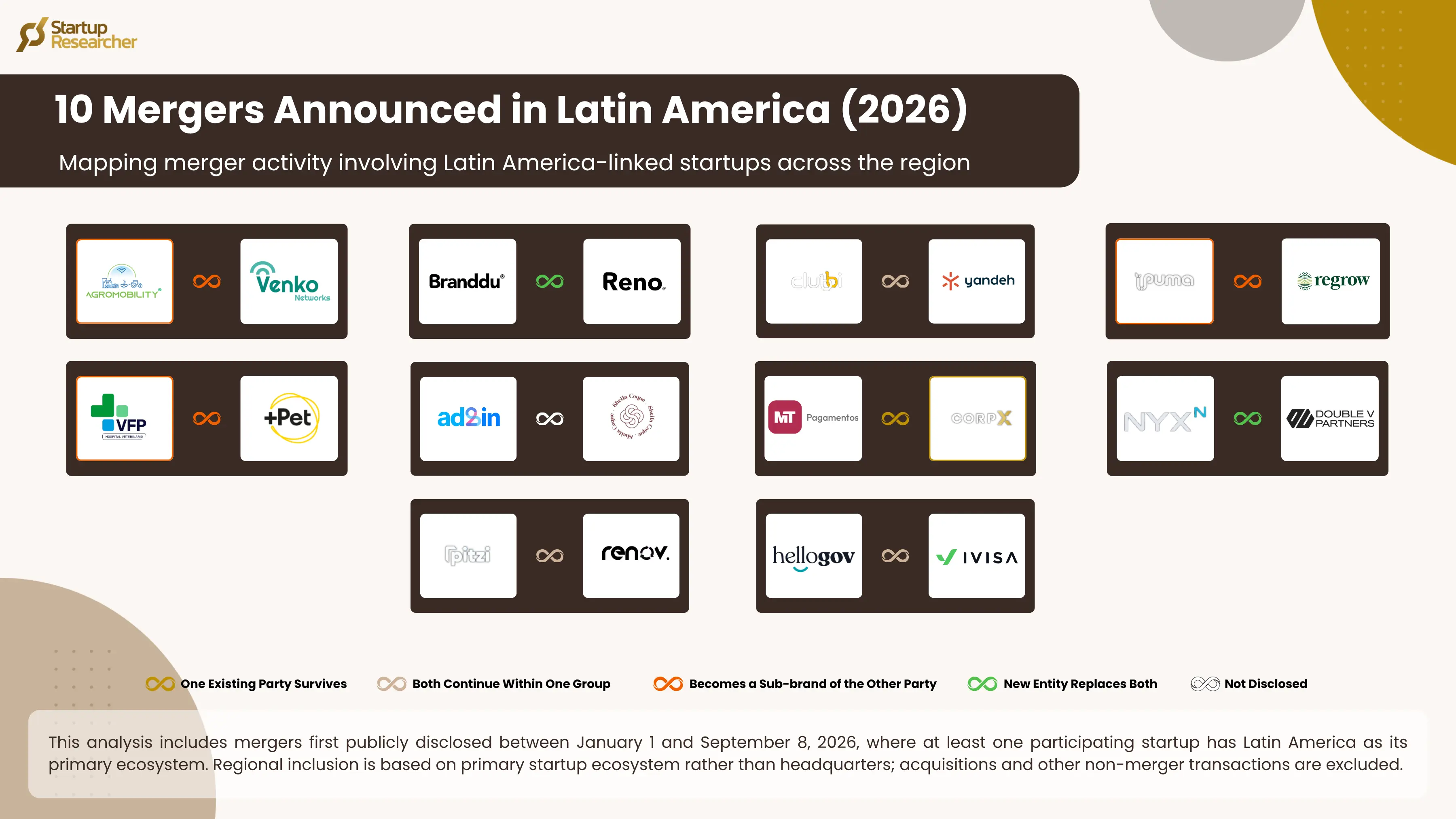
Latin America’s startup ecosystem recorded merger activity across fintech, agritech, telecommunications, enterprise software, and other sectors in 2026. Startup Researcher has comprehensively mapped 10 mergers involving startups and scaleups connected to the region, first publicly disclosed between January 1 and September 8, 2026. The mapping covers six domestic Brazilian combinations and four cross-border mergers, highlighting the companies involved and their resulting business structures.
Methodology
This analysis covers merger transactions first publicly disclosed between January 1 and September 8, 2026, when at least one independent startup or scaleup was primarily associated with Latin America’s startup ecosystem. Transactions are ordered by the earliest public disclosure identifying the merger, rather than the date of preliminary negotiations, regulatory approvals, or legal completion. The list includes completed mergers that were disclosed within the period even when the legal combination occurred earlier.
Primary ecosystem was assessed using founding roots, the development of the business and its founders, core operations, market presence, and credible startup-industry recognition. The qualifying company had to be independently founded, privately held, and built around a scalable product, technology, platform, or business model; traditional service firms and mature businesses were excluded unless credible startup-ecosystem evidence supported their inclusion. For combinations involving an established company, the Latin American party had to meet those startup or scaleup criteria.
Acquisitions, minority or controlling stake purchases presented as acquisitions, joint ventures, partnerships, asset purchases, and internal reorganizations were excluded. Where the parties publicly characterized a business combination as a merger, that description was retained even if legal documentation used different transaction mechanics. Financial values are reported as merger consideration only when credible public sources explicitly identify them as transaction values, excluding post-merger company valuations, revenue projections, financing rounds, and other operating metrics.