Mexican startups attracted acquisition interest in 2026 as buyers pursued specialized technology, established customer relationships, operating capabilities, and regional market access. Between January 1 and September 8, 11 acquisitions involving Mexican startup acquirees were publicly disclosed or confirmed. Together, the transactions reflect selective consolidation and strategic expansion across Mexico’s startup ecosystem.
Methodology
This mapping covers acquisitions of Mexican startups first publicly announced between January 1 and September 8, 2026. Pending agreements and completed acquisitions were included and listed chronologically by their earliest public announcement date, rather than their closing or regulatory approval date.
The acquiree had to be a startup primarily associated with Mexico’s startup ecosystem before the transaction. Eligibility considered its founding roots, core operations, principal market, and recognized ecosystem identity. A startup could therefore qualify even if its headquarters or legal domicile was outside Mexico. Traditional service providers, mature corporations, and businesses not credibly classified as startups were excluded.
The buyer could be based anywhere and could be a startup, corporation, investment firm, or other organization. Transactions were checked using available first-party statements and credible media reports. Deals announced in another year were excluded, even if they received additional coverage in 2026.
Minority investments, funding rounds, asset-only purchases, and mergers without a clearly identifiable acquirer and acquiree were excluded.
Mexico’s Startup Acquisition Landscape
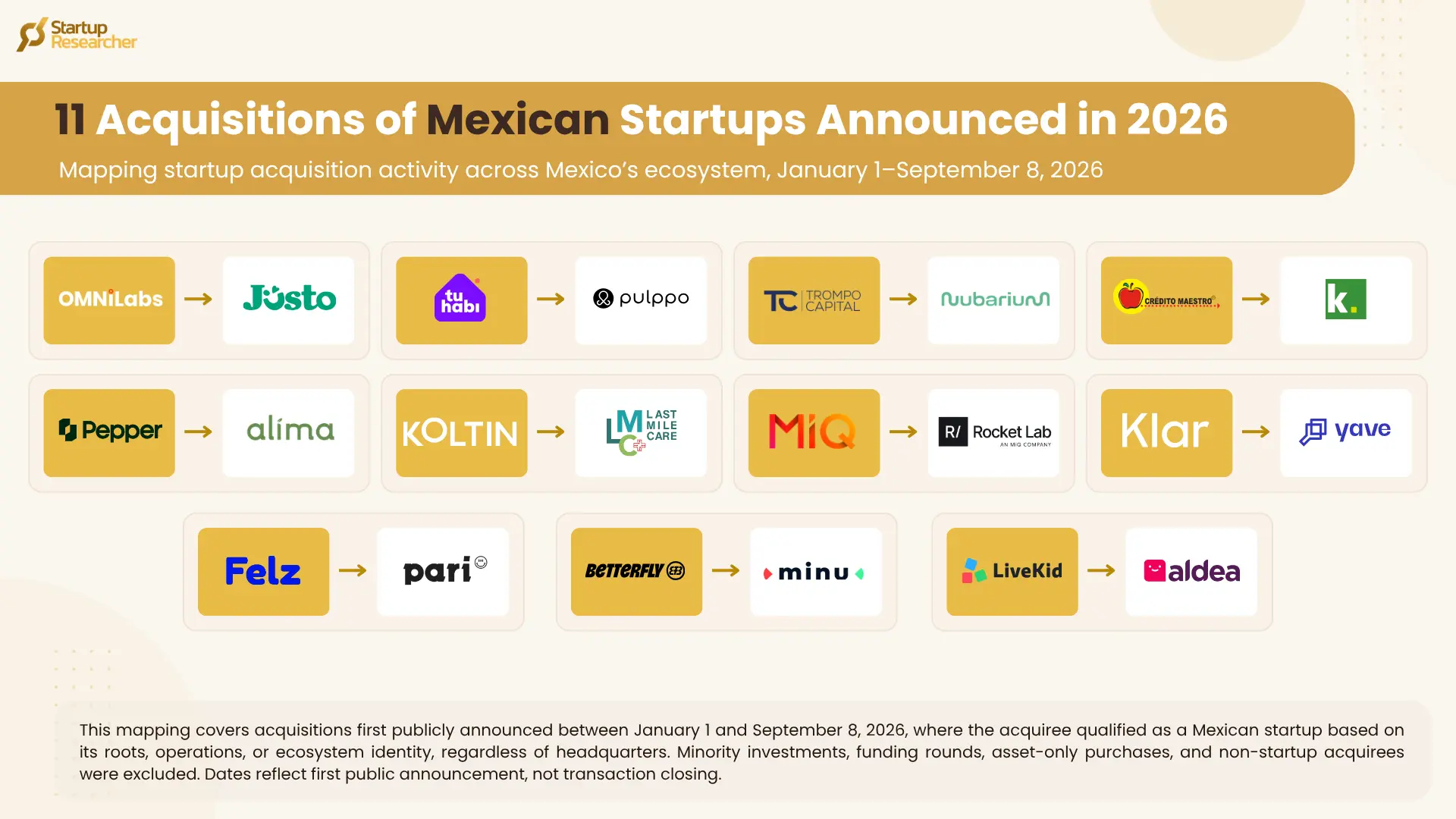
Mexico’s startup acquisition activity in 2026 reflects several strategic objectives rather than a single wave of consolidation. International buyers used Mexican targets to deepen their presence in Mexico and Latin America, while others pursued specialized technology, local expertise, established customer relationships, or complementary products. Across 11 acquisitions, the transactions position Mexican startups as strategic assets for regional expansion and capability building.
Grupo OMNi Acquires Jüsto
On January 13, 2026, Costa Rica’s Grupo OMNi announced its acquisition of shares in Jüsto USA, the holding company behind Mexico’s online grocery platform. The transaction gave Grupo OMNi control of the business and supported Jüsto’s planned return to the Mexican market. Grupo OMNi also announced a US$100 million first-year capital injection to finance the relaunch and renewed operations.
Tuhabi Acquires Pulppo
Colombian proptech Habi, which operates in Mexico as Tuhabi, disclosed its acquisition of Pulppo on January 26, 2026. Pulppo contributes a commercial platform serving 100 brokerages and 800 brokers, while Tuhabi provides liquidity, market data, and transaction infrastructure. Pulppo will remain an independent brand within a broader platform designed to improve agent productivity and support commercial growth.
Trompo Capital Acquires Nubarium
The January 27, 2026 acquisition of Nubarium gave Trompo Capital ownership of a Mexican startup specializing in digital identity and regulatory compliance technology. Nubarium’s platform supports identity validation, biometric checks, customer verification, secure onboarding, and other compliance processes. The acquisition is intended to provide additional backing, strengthen the company’s technology, and accelerate its growth across Mexico and Latin America.
Grupo Empresarial Maestro Agrees to Acquire Control of Kubo Financiero
The proposed acquisition of control of Kubo Financiero by Grupo Empresarial Maestro, which operates under the Crédito Maestro brand, was publicly reported on February 13, 2026. Kubo’s audited financial statements show that a share purchase agreement had been signed on August 22, 2025 and that MXN 610 million in contributions for future capital increases had been fully paid, but their conversion into shares remained subject to contractual conditions and authorization from Mexico’s National Banking and Securities Commission. As of July 14, the change of control was still awaiting that authorization, and no subsequent confirmation of completion was identified through September 8.
Pepper Acquires Alima
Pepper’s acquisition of Alima, announced on March 25, 2026, brought the Mexican startup’s product-content, data, and artificial intelligence capabilities into its platform. Alima developed technology for smaller food distributors and previously received backing from Y Combinator. Co-founders Jorge Vizcayno and Blanca Espinosa joined Pepper to lead product-content infrastructure and AI-enabled implementation.
Koltin Acquires Last Mile Care
Koltin disclosed its acquisition of Last Mile Care on April 6, 2026, adding home-based infusions, therapies, and post-hospitalization services to its healthcare offering. Koltin will integrate these visits with its clinical and telemedicine services, allowing patients to receive coordinated care beyond traditional medical facilities. The combination is intended to improve monitoring and enable earlier intervention, while Last Mile Care’s founders continue in leadership roles.
MiQ Acquires Rocket Lab
On April 7, 2026, MiQ announced an agreement to acquire Rocket Lab, expanding its capabilities in mobile advertising and app-growth marketing. Founded in 2019, Rocket Lab has built a presence across Latin America and other international markets. The company continues to operate as an independent MiQ business unit under founder and CEO Juan Echavarria Coll, while contributing its mobile-performance technology, regional expertise, and customer relationships to MiQ’s broader advertising platform.
Klar Acquires Yave
On May 18, 2026, Klar announced the acquisition of Yave, a Mexican technology company that pioneered fully digital mortgage lending in the country. The combination brings Klar’s data-driven financial infrastructure together with Yave’s mortgage expertise to support faster and more transparent home financing. Klar said the integration would support its future expansion into digital mortgages and other collateralized lending products.
Felz Acquires Pari Delivery
The May 25, 2026 acquisition of Pari Delivery added rapid-delivery infrastructure to Felz’s network of technology-enabled neighborhood stores. Pari contributes logistics, dark-store operations, order management, and digital customer-service capabilities focused on beverages and tobacco products. Felz plans to use this infrastructure to broaden its delivery coverage and strengthen its operating foundation in Mexico’s traditional grocery market.
Betterfly Acquires Minu
Betterfly announced its acquisition of Mexican employee-benefits platform Minu on June 10, 2026. Diario Financiero reported, citing sources, that the transaction closed at US$100 million, although the companies did not publicly disclose the purchase price. Minu adds financial-wellness services to Betterfly’s existing physical, mental, and emotional well-being offering while strengthening its position in Mexico. The acquisition also accompanies Betterfly’s preparations to enter the United States employee-benefits market in 2027.
LiveKid Acquires Aldea
On June 24, 2026, LiveKid announced its acquisition of Monterrey-based childcare-management software provider Aldea as part of its expansion across Latin America. The transaction adds Aldea’s regional expertise and customer relationships across Mexico, Colombia, and Chile. Aldea will retain its brand, with Jorge Dzul leading operations across Mexico and Latin America and Luis Garza Sada joining LiveKid’s board of directors.
The acquisitions publicly disclosed in 2026 show that startups associated with Mexico’s ecosystem attracted buyers for their technology, specialized expertise, customer relationships, and regional reach. The transactions supported objectives ranging from product and capability expansion to geographic growth and operational integration. At the September 8 cutoff, Kubo Financiero’s proposed change of control remained subject to regulatory approval.