Australian startups attracted acquisition interest throughout the third quarter of 2026 as buyers pursued specialized technologies, established software platforms, intellectual property, and operating capabilities. Between July 1 and September 30, 15 qualifying acquisitions involving companies primarily associated with Australia's startup ecosystem were publicly disclosed or confirmed. The transactions spanned artificial intelligence, financial technology, digital media, biotechnology, sports technology, workforce platforms, renewable energy, consumer intelligence, and personalized nutrition.
Methodology
This mapping covers acquisitions whose first qualifying public announcement occurred between July 1 and September 30, 2026, regardless of signing or completion date. Binding acquisition agreements and formal takeover bids were included even when completion remained pending. Non-binding letters of intent and other preliminary, non-binding acquisition proposals were excluded. Transactions are listed chronologically by their earliest qualifying public announcement.
Eligible targets had to be independently founded startups or startup-origin scaleups with a substantive connection to Australia's startup ecosystem. Eligibility considered founding history, operations, and recognition within the startup ecosystem, including qualifying university and research spin-offs. Eligibility was assessed from the origins of the operating business, rather than incorporation or rebranding dates alone. Ventures developed within established non-startup businesses, targets founded as corporate joint ventures, and successor businesses built on operations or technology inherited from established non-startup businesses were excluded. Traditional service providers, established non-startup businesses, and companies without a meaningful Australian connection were also excluded.
The buyer could be based anywhere and could be a startup, corporation, investment firm, or another type of organization. Eligible transactions included full-company acquisitions and controlling takeovers. Acquisitions of substantial startup operating businesses, including through asset transfers or joint ventures, also qualified. Joint ventures formed to acquire an otherwise eligible startup operating business could qualify. Minority investments, funding rounds, mergers, and isolated intellectual property purchases were excluded.
Where public disclosures used conflicting descriptions, such as acquisition, merger, or business combination, inclusion required sufficient evidence of a qualifying acquisition structure and the resulting ownership and control arrangements. Transactions were excluded when these elements could not be established.
Transactions were verified through official announcements, regulatory disclosures, and credible media reporting. Acquisition values reflect publicly reported figures, including conditional payments where applicable. Transaction completion dates and financial terms are clarified where relevant.
Australia's Startup Acquisition Landscape
AI Capabilities Featured in More Than Half of Acquisitions
At least nine of the 15 Australian startup acquisition transactions announced in Q3 2026, representing 60%, involved businesses with identifiable AI-related products or capabilities. These included Converlens, Telescope AI, Hall, Jenesys, Expert360, Daisee, Paradino, Formbay, and The U Group & Co. Their applications spanned stakeholder analytics, investment research, brand visibility, autonomous systems, talent matching, conversation analysis, financial advice, renewable energy compliance, and consumer intelligence.
At Least Four Acquisitions Followed Existing Business Relationships
At least four of the 15 transactions, or 26.7%, involved buyers with established commercial or investment relationships with their targets before the acquisition. Open Point had worked with Converlens, EasyEquities was Telescope AI's first enterprise partner, Novonesis had invested in MicroBioGen in 2013, and NielsenIQ had maintained a five-year partnership with The U Group. These transactions illustrate how acquisitions can build on existing access to specialized technology, commercial relationships, and product expertise rather than beginning with an entirely new buyer-target relationship.
Nearly Three-Quarters of Targets Were Established by 2020
11 of the 15 acquired startup businesses, representing 73.3%, were founded or established by 2020, with a median founding year of 2018. The range extended from MicroBioGen, established in 2001, and GymAware, founded in 2002, to much younger businesses such as Paradino, founded in 2024, and Jenesys, incorporated in 2025. This age distribution highlights the role of established startup-origin technology businesses alongside younger ventures, with acquisition interest spanning companies at substantially different stages of development.
Australian Startup Acquisitions in Q3 2026
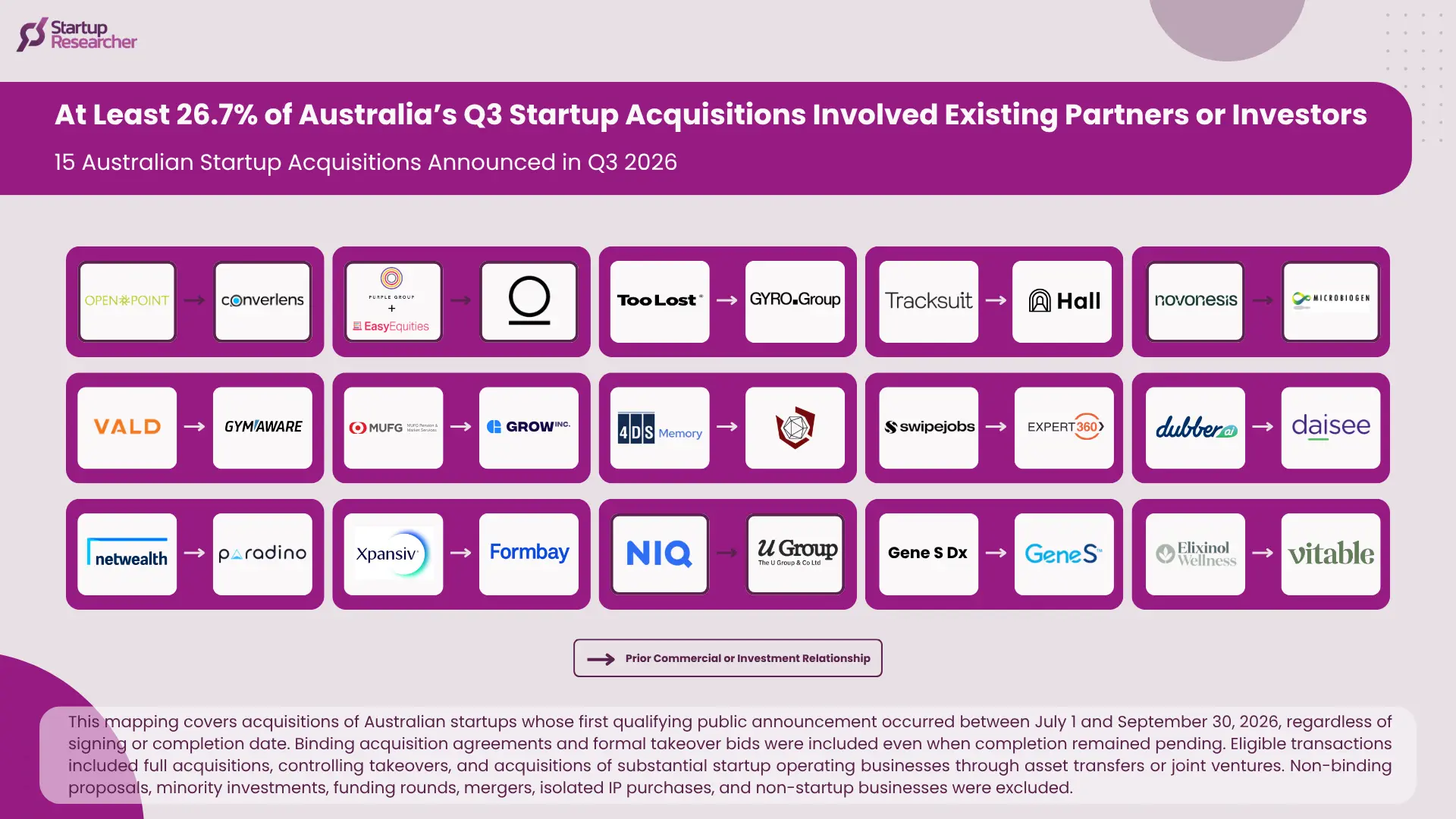
Open Point Acquires Converlens
Open Point announced its acquisition of Australian artificial intelligence startup Converlens on July 6, 2026, expanding its community and stakeholder engagement technology capabilities. Developed from a government innovation initiative in 2017, Converlens created a platform that applies natural language processing and artificial intelligence to analyze consultation submissions, stakeholder feedback, and other qualitative information. The acquisition integrates Converlens' analytical technology with Open Point's engagement and relationship management products, strengthening its offering for government, infrastructure, utilities, and regulated industries.
Purple Group and EasyEquities Acquire Telescope AI
South Africa's Purple Group and its subsidiary EasyEquities announced an agreement on July 13, 2026, to acquire 100% of Australian-founded fintech startup Telescope AI for up to US$10.75 million. Under the agreement, Purple Group and EasyEquities would each acquire a 50% interest, with US$7 million payable at closing and up to US$3.75 million in deferred consideration. Telescope AI developed artificial intelligence-powered investment research, discovery, and compliance technology used by brokerage platforms, and the acquisition is intended to expand its products across Purple Group's financial services ecosystem.
Too Lost Acquires GYRO.Group
US-based independent music distribution platform Too Lost announced its acquisition of Australian music technology company GYRO.Group on July 15, 2026, expanding its presence across the Asia-Pacific region. Founded in Brisbane in 2018 as GYROstream by Andy Irvine, Andrew Wilson, Alex Wilson, and Viv Mellish, the company developed a digital distribution platform that subsequently expanded into artist services, publishing, marketing, and white-label music distribution. The completed transaction involved the acquisition of 100% of GYROstream Holdings, bringing platforms including G.Y.R.O. and DistroDirect into Too Lost's international business.
Tracksuit Acquires Hall
New Zealand-founded brand tracking platform Tracksuit announced its acquisition of Sydney-based artificial intelligence startup Hall on July 20, 2026. Founded in 2023 by Kai Forsyth, Hall developed technology that measures how brands appear, are described, and are recommended within artificial intelligence assistants and search experiences. The acquisition brings Hall's four-person team into Tracksuit and connects AI visibility monitoring with its existing brand awareness and consumer perception data, allowing marketers to evaluate how their brands perform across both human and machine-generated responses.
Novonesis Acquires MicroBioGen
Danish biotechnology company Novonesis announced an agreement on August 10, 2026, to acquire the remaining ownership interest in Australian industrial biotechnology company MicroBioGen. Established in 2001 as a Macquarie University spin-off, MicroBioGen developed proprietary yeast-breeding technology for bioethanol production and other industrial fermentation applications. The acquisition builds on Novonesis’ 2013 investment and more than a decade of collaboration. Novonesis previously held a 23% stake, and the transaction to acquire the remaining shares was completed on October 1, following regulatory approval.
VALD Acquires GymAware
Australian sports technology company VALD announced the acquisition of Canberra-founded GymAware on August 11, 2026, combining two businesses specializing in performance measurement and athlete monitoring. Developed by Evan Lawton and Rob Shugg, GymAware built velocity-based training technology that measures barbell movement and provides objective strength-training data for coaches, athletes, and researchers. Its GymAware and FLEX products will complement VALD's existing performance assessment systems, extending the company's capabilities into strength training and connecting gym-based performance data with its wider sports science technology ecosystem.
MUFG Pension & Market Services Acquires GROW Inc
MUFG Pension & Market Services announced a proposed acquisition of Australian fintech company GROW Inc on August 28, 2026, through a binding scheme implementation agreement. Originating as GROW Super in 2017, the startup evolved into a technology-driven superannuation administration provider, developing its DLTA platform to modernize fund administration, data management, and member services. At announcement, completion remained subject to regulatory, shareholder, court, and other required approvals. The ACCC subsequently approved the proposed acquisition on October 6.
4DS Memory Acquires Jenesys
Australian semiconductor technology company 4DS Memory announced an agreement on August 31, 2026, to acquire 100% of Jenesys, an Australian edge-AI and autonomous systems startup. Jenesys developed its Distributed Autonomy Stack to coordinate multiple unmanned systems across air, land, sea, and space, with technology designed to operate in environments where communications and GPS connectivity may be disrupted. The acquisition combines Jenesys' software capabilities with 4DS Memory's resistive memory technology, with consideration including A$5 million in shares, a deposit of A$150,000, and performance-linked rights; the transaction was completed on October 9.
Swipejobs Acquires Expert360
Swipejobs' acquisition of Expert360 was first publicly reported on September 2, 2026, before being confirmed by the Australian startup on September 4. Founded in Sydney in 2013 by Bridget Loudon-Harris and Emily Yue, Expert360 developed a digital marketplace connecting businesses with independent consultants and specialist professionals. The acquisition brings Expert360's Australian and New Zealand talent network and corporate relationships into Swipejobs' technology-driven recruitment operations.
Dubber Corporation Acquires Daisee Business Assets
Dubber Corporation announced an agreement on September 11, 2026, to acquire selected operating assets of Australian artificial intelligence startup Daisee for up to A$1.25 million. Founded in 2017 by Richard Kimber, Daisee developed conversational intelligence software for analyzing customer interactions, particularly in financial services and insurance. The transaction covers customer contracts, proprietary technology, intellectual property, selected supplier agreements, and the expected transfer of certain employees, representing an operating-business asset acquisition rather than the purchase of Daisee's entire legal entity, with completion initially expected in October.
Netwealth Group Acquires Paradino
Netwealth Group announced its agreement to acquire 100% of Paradino on September 15, 2026, for up to A$29 million, including conditional consideration. Founded in 2024 by Alex Gassner and Josh Ratnarajah, the Sydney startup developed an artificial intelligence-powered financial advice platform that automates meeting notes, compliance workflows, advice documentation, and administrative processes. Paradino supported more than 500 financial advisers and generated approximately A$1.6 million in annual recurring revenue, while Netwealth separately committed A$10 million toward future development, with completion initially expected by the end of October.
Xpansiv Acquires Formbay
Xpansiv announced a definitive agreement to acquire Formbay on September 16, 2026, expanding its renewable energy certificate and environmental market infrastructure capabilities. Founded in Sydney in 2010 by Dan Sullivan, Formbay developed software for solar installation verification, compliance management, and renewable energy certificate processing, with its platform facilitating more than A$1 billion in certificate transactions during 2025. The acquisition will integrate Formbay's verification technology and industry relationships into Xpansiv's international platform, with financial terms undisclosed and completion subject to regulatory approval.
NielsenIQ Acquires The U Group & Co
NielsenIQ announced a friendly off-market takeover bid for Australian consumer intelligence company The U Group & Co on September 22, 2026, seeking to acquire all outstanding shares through its Australian subsidiary. Founded in Perth, The U Group developed ReceiptJar, a consumer rewards application that collects consent-based shopping data and transforms purchase information into commercial insights using artificial intelligence. The acquisition is intended to expand NielsenIQ's consumer intelligence capabilities, and on October 8 the company confirmed that shareholder acceptances had exceeded 90%, allowing the remaining compulsory-acquisition process to proceed.
Gene S Dx Acquires Gene S Business and Rosa Platform
Gene S Dx's acquisition of the Gene S operating business, Rosa pharmacogenomics platform, and associated intellectual property was publicly reported on September 23, 2026. Founded in Western Australia in 2020 by Dr. Svetlana Baltic and Dr. Suzanna Lindsey-Temple, Gene S developed genetic testing and clinical interpretation technology intended to support personalized medication selection and dosing. Its Rosa platform applies pharmacogenomics to help healthcare providers understand how genetic differences may affect patients' responses to medications.
The transaction was carried out through Gene S Dx, a newly established joint venture owned in equal thirds by Syngenis Ventures, the Perron Institute, and Gene S's original founders. The new company acquired Gene S's existing operating business, proprietary Rosa technology, and associated development intellectual property, while the founders retained a collective one-third ownership interest and continued in leadership roles.
Elixinol Wellness Acquires Vitable
Elixinol Wellness announced a binding term sheet on September 24, 2026, to acquire the operating business assets of Vitable, an Australian personalized nutrition startup founded in 2019 by Larah Loutati and Ilyas Anane. Consideration is payable entirely in Elixinol shares and comprises A$1.25 million in unconditional staged payments, up to A$1.25 million linked to revenue and earnings targets, and a potential additional A$1 million linked to Elixinol’s market capitalization, bringing maximum consideration to A$3.5 million. Vitable developed a subscription-based supplement platform supported by approximately 7,850 active subscribers, and the acquisition is intended to strengthen Elixinol's personalized wellness and recurring-revenue capabilities, subject to due diligence, shareholder approval, and other closing requirements.
Of the 15 qualifying transactions, four were first publicly announced in July, four in August, and seven in September, with acquisitions involving both established technology companies and emerging startups. The transactions included company acquisitions, takeover agreements, and purchases of established startup operating businesses and associated assets, reflecting a range of acquisition structures. The activity highlights continued demand for Australian-developed technology and specialized capabilities, although the mix of completed transactions, pending agreements, contingent consideration, and undisclosed prices limits direct comparisons of acquisition values.