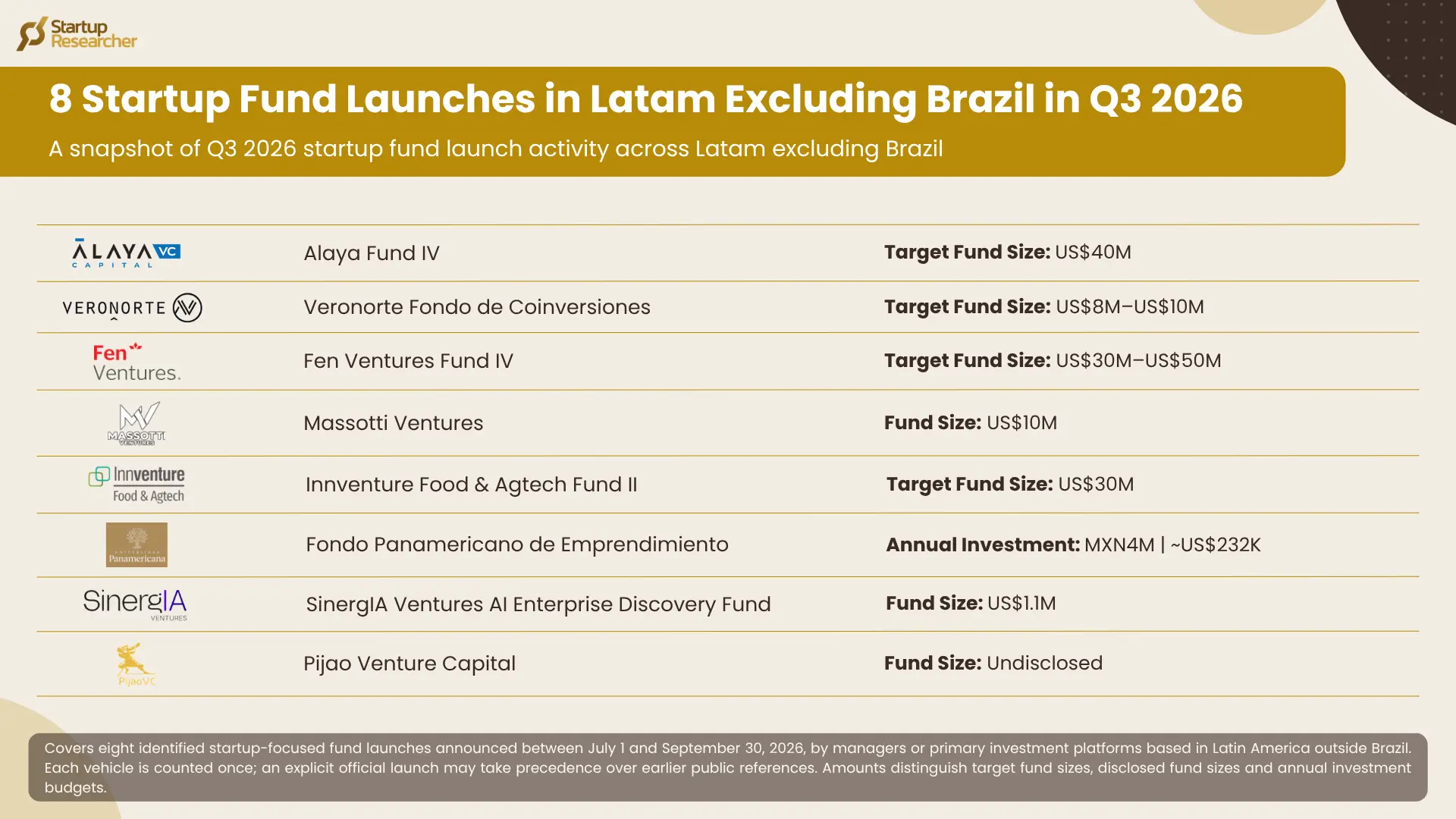
Latin America excluding Brazil recorded eight identified startup-focused fund launches during the third quarter of 2026 through September 30, spanning eight distinct investment vehicles. Activity was concentrated in early-stage venture capital, with strategies covering artificial intelligence, enterprise software, fintech, agrifood technology, university-backed startup financing, international technology co-investments, and regional micro-VC. The launches were connected to investment ecosystems in Argentina, Chile, Mexico, and Colombia, while several vehicles targeted startups across international markets.
Methodology
This analysis covers publicly announced launches of startup-focused investment funds between July 1 and September 30, 2026. A qualifying launch is a verifiable public announcement that an identifiable investment fund or vehicle was created, introduced, formally launched, or began fundraising. The earliest qualifying announcement is generally used; however, an explicit launch announcement by the fund manager or sponsoring institution may establish the launch date despite earlier public references to the initiative. Subsequent media coverage, fundraising closes, and investor commitments are not counted as separate launches.
To qualify, a vehicle had to deploy investment capital directly into startups as a material part of its mandate. Eligible structures include traditional venture capital funds, university-backed startup investment vehicles, specialist sector funds, and regional microfunds. Private equity funds primarily targeting mature or middle-market companies, broad impact vehicles without a dedicated startup mandate, fund-of-funds, angel networks, syndicates, accelerators without an investment vehicle, grants, subsidies, debt-only vehicles, and proposed funds without a sufficiently established launch were excluded.
The geographic scope covers Latin America excluding Brazil. Vehicles were included when their fund manager or primary investment platform was based in an eligible Latin American market outside Brazil, including funds with broader regional or international strategies. Brazil-based managers and vehicles were excluded even when their mandates extended across Latin America, while a fund was not excluded solely because its investment strategy or operating footprint included Brazil alongside other markets.
Fund amounts are reported according to how they were publicly presented. Fundraising objectives are described as target fund sizes, capital pools presented as fund sizes are reported as disclosed fund sizes, and recurring investment allocations are treated as annual investment budgets rather than total fund capitalization. Where no total fund size was publicly disclosed, no amount is inferred.
Using these criteria, eight qualifying startup-focused fund launches were identified during Q3 2026.
Latin America's Q3 Startup Fund Launches (Excluding Brazil)
Alaya Fund IV
Alaya Capital began raising its fourth fund in July with a target of US$40 million for investments in early-stage Latin American startups. The Argentina-founded venture firm invests across markets including Argentina, Chile, Peru, Colombia, and Mexico, continuing a regional strategy focused on technology companies with the potential to expand across multiple markets. Fund IV follows Alaya's third fund, a US$25 million vehicle that helped strengthen the firm's regional investment platform.
Alaya has historically backed companies at early stages of development, and Fund IV is positioned to continue investing around the Seed and Series A stages. Its regional mandate gives the manager flexibility to identify companies across several of Latin America's largest startup ecosystems rather than concentrating capital in a single domestic market. The US$40 million target would provide a larger pool of capital for backing founders as they move from initial product development toward regional expansion.
Veronorte Fondo de Coinversiones
Colombia-based venture capital manager Veronorte launched its Fondo de Coinversiones in July, targeting US$8 million to US$10 million to invest directly in approximately 10 to 12 technology companies. Founded by Camilo Botero and Felipe Valencia, the firm developed the new vehicle as an extension of its existing investment platform, which connects Latin American capital with leading venture capital managers in the United States. Unlike Veronorte's fund-of-funds structure, the new vehicle is designed to make direct co-investments alongside established venture capital partners.
The strategy focuses on accessing selected technology companies within the portfolios of Veronorte's partner funds, giving Latin American investors exposure to opportunities traditionally associated with major institutional investors. Before launching the vehicle, Veronorte had already completed proprietary investments in companies including AI hardware developer Positron, AI search platform Perplexity, and battery technology company Coreshell. These earlier investments illustrate the firm's approach to technology co-investment, although they were made before the new fund's launch.
Massotti Ventures
Massotti Ventures was launched in July by Argentine entrepreneur Matías Massotti to back Latin American startups with regional and international expansion potential. The US$10 million vehicle primarily targets Pre-seed and Seed companies and plans to build a portfolio of approximately 15 to 20 startups. Initial investments are expected to range from US$50,000 to US$200,000 per company, with capital reserved for follow-on investments in the strongest-performing portfolio companies.
The fund is particularly focused on helping founders move beyond their initial domestic markets and develop links with the United States. Its strategy combines early-stage capital with support around international expansion, including connections to the Silicon Valley ecosystem. Publicly identified areas of interest include applied artificial intelligence, fintech, Web3, SaaS, and HealthTech.
Innventure Food & Agtech Fund II
Innventure Food & Agtech launched its second fund in August with a target of US$30 million to invest in approximately 35 agrifood technology startups. The vehicle targets companies from Pre-seed through Series A and was launched with an operating base in Argentina and plans to establish additional bases in Brazil and the United States. Its strategy is centered on technologies capable of improving productivity, efficiency, resilience, and innovation throughout agricultural and food value chains.
The fund plans to back companies developing solutions across areas including artificial intelligence, biotechnology, automation, and data-driven agricultural technology. Innventure's model emphasizes validating technologies in real production environments before supporting broader commercial expansion. Fund II increases the scale of the firm's investment activity after its first vehicle established a portfolio of agrifood technology companies operating across international markets.
Fondo Panamericano de Emprendimiento
Universidad Panamericana launched the Fondo Panamericano de Emprendimiento in August to provide private capital to high-potential startups connected to its entrepreneurship and innovation ecosystem. The initiative focuses particularly on technology-based projects and companies with potential social impact, primarily targeting businesses at the Pre-seed and Seed stages. Eligible startups must have at least one founder who graduated from Universidad Panamericana or commercialize technologies and innovations developed within the institution.
Rather than announcing a conventional total fund capitalization, the initiative established an annual investment allocation of MXN4 million. It plans to support approximately four to eight startups each year, with average investments of MXN500,000 and a maximum investment of MXN800,000 per company. The fund primarily targets opportunities in Mexico, while international projects may also be evaluated when they meet the initiative's eligibility and innovation requirements.
Fen Ventures Fund IV
Fen Ventures publicly introduced its fourth investment vehicle in July as a new fund for early-stage, high-growth Latin American startups, with further fundraising details disclosed in August. The Chilean venture manager is targeting between US$30 million and US$50 million and plans to construct a portfolio of approximately 20 to 30 companies. The vehicle continues Fen's regional strategy while moving further into opportunities created by the accelerating development and adoption of artificial intelligence.
The fund is moving earlier in the startup lifecycle, with Fen emphasizing opportunities created by artificial intelligence and broader technological disruption. Initial investments are expected to range from US$200,000 to US$500,000, with follow-on capacity of up to US$1.5 million per company. At launch, Fen expected to achieve its first close and begin investing during the second half of 2026.
SinergIA Ventures AI Enterprise Discovery Fund
Digital Hub Monterrey and AngelHub Ventures launched the SinergIA Ventures AI Enterprise Discovery Fund in August as a US$1.1 million early-stage venture fund. The vehicle targets Pre-seed and Seed startups developing artificial intelligence and enterprise technology solutions, with a particular focus on B2B companies capable of selling into corporate markets. Its geographic mandate extends across Latin America while maintaining a strong connection to Mexico's technology and corporate ecosystem.
The fund plans to invest in roughly 10 to 15 startups, with initial checks generally ranging from US$50,000 to US$100,000. AngelHub Ventures manages the vehicle as general partner, while Digital Hub Monterrey gives participating companies access to a network of corporations and technology partners. This combination is designed to help portfolio startups test products, execute pilots, build commercial references, and accelerate their entry into the Mexican market.
Pijao Venture Capital
Pijao Venture Capital officially launched in September during FESTECH 2026 in Ibagué as a regional microfund focused on expanding venture investment access for startups in Colombia's Tolima region. The vehicle was presented during a DemoDay that connected local technology companies with professional investors and formed part of a wider effort to develop a more structured venture-capital ecosystem outside Colombia's largest startup centers. Its launch introduced a dedicated local investment vehicle into an ecosystem where access to institutional early-stage capital has historically been more limited.
Pijao Venture Capital was unveiled during a DemoDay associated with the Pijao Rocket Place Accelerator, connecting startups from Tolima with professional investors. FESTECH described Pijao Venture Capital as a microfund intended to expand investment in regional startups, but did not disclose a detailed investment thesis for the vehicle. A total capitalization for Pijao Venture Capital was not publicly disclosed at the time of its launch.
Latin America excluding Brazil recorded eight identified startup-focused fund launches in Q3 2026, with managers based in Argentina, Chile, Mexico, and Colombia. Among the vehicles with disclosed or targeted US-dollar fund sizes, amounts ranged from SinergIA Ventures' US$1.1 million fund to Fen Ventures Fund IV's US$30 million to US$50 million target, while Fondo Panamericano disclosed an annual MXN4 million investment allocation and Pijao Venture Capital did not disclose a total fund size. The launches combined predominantly early-stage regional strategies with more specialized approaches to AI, agrifood innovation, university-backed financing, international technology co-investments, and regional venture capital access.