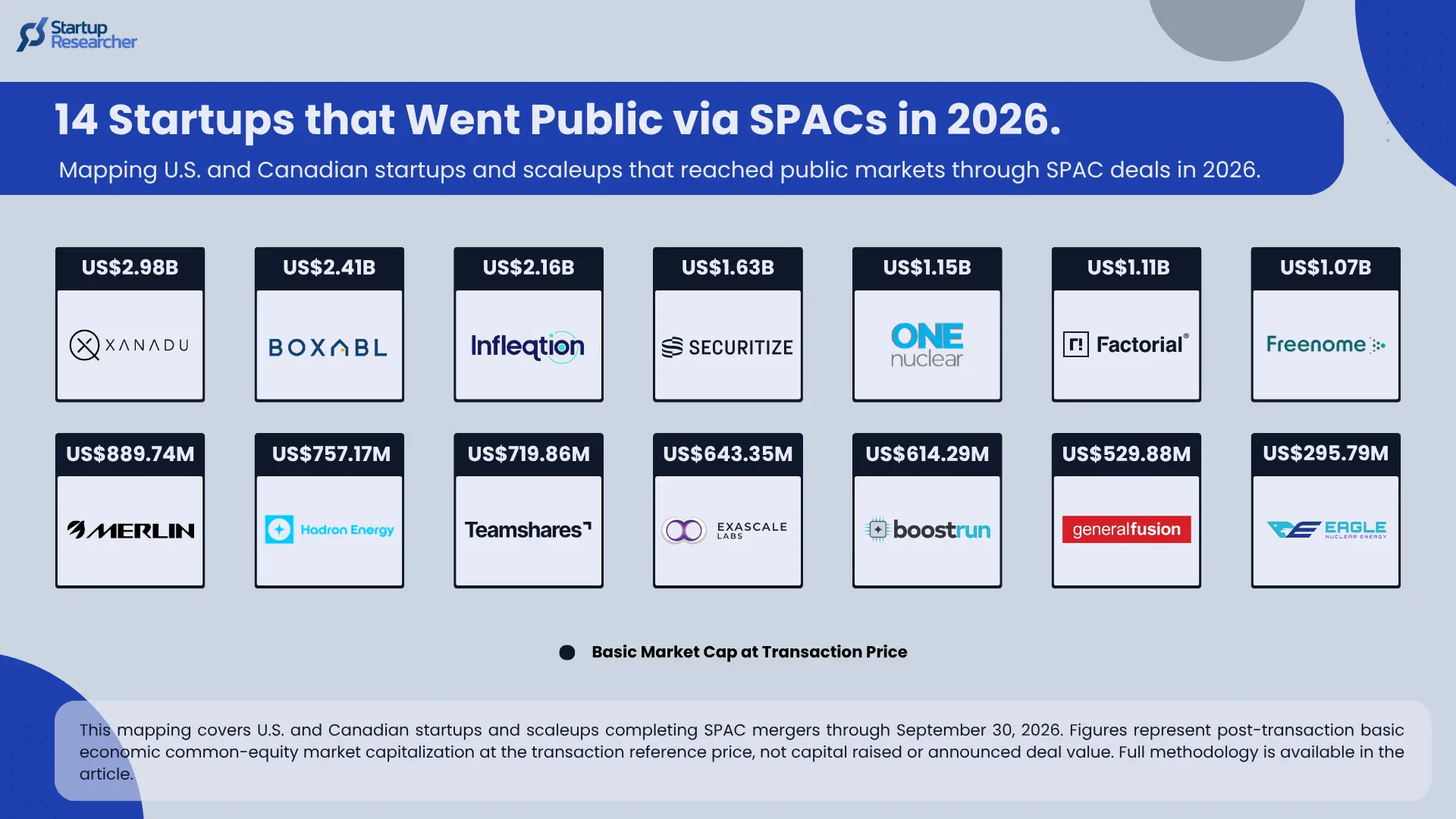
Through September 30, 2026, 14 U.S. and Canadian startups and scaleups reached public markets through completed SPAC business combinations. Together, they represented approximately US$16.98 billion in basic market capitalization at their respective transaction prices, led by Xanadu Quantum Technologies at US$2.98 billion, BOXABL at US$2.41 billion, and Infleqtion at US$2.16 billion. The group spans sectors including energy, quantum computing, AI infrastructure, fintech, MedTech, construction technology, and autonomous aviation.
Methodology
This list covers U.S. and Canadian startups and scaleups that completed a business combination with a special purpose acquisition company between January 1 and September 30, 2026. The mapping includes companies founded and primarily built within the U.S. or Canadian startup ecosystems. Subsequent international expansion, additional headquarters, or a U.S. stock-market listing does not by itself determine whether a company is considered U.S. or Canadian.
For this analysis, a startup or scaleup is an independently founded, innovation-driven company built around a scalable product, technology, platform, or business model that was privately held immediately before completing its SPAC business combination. Traditional businesses without a credible startup or scaleup identity, already-public operating companies, subsidiaries of established corporations, internal reorganizations, and SPAC vehicles themselves are excluded.
Acquisition-led companies can qualify where the independently founded platform had an established operating history and scalable business model before the SPAC transaction. Newly formed holding, acquisition, or consolidation platforms whose substantive operating activities, revenues, or capabilities are primarily created through acquisitions completed in connection with the SPAC transaction are excluded.
Basic Market Cap at Transaction Price represents the value of a company's basic economic common equity immediately following the business combination. It is calculated using the post-transaction basic economic common share count and the per-share transaction reference price used to determine the applicable merger consideration.
The measure excludes warrants, options, unvested equity awards, separate earnout or other contingent securities that had not converted into basic economic common equity at closing, preferred or convertible securities that remained outstanding as separate instruments after closing, and shares carrying voting rights without corresponding economic ownership. It should therefore not be confused with announced transaction value, enterprise value, fully diluted equity value, PIPE financing, SPAC trust proceeds, or the amount of cash ultimately delivered to the company.
Totals are calculated using unrounded underlying values and may therefore differ slightly from the sum of the displayed figures.
Startups That Went Public Through SPACs in 2026
Xanadu Quantum Technologies
Ticker: XNDU | Exchange: Nasdaq / Toronto Stock Exchange | Sector: Semiconductors, Electronics & Hardware | Basic Market Cap at Transaction Price: US$2.98 billion
Xanadu Quantum Technologies became publicly traded after completing its business combination with Crane Harbor Acquisition Corp. The Toronto-based company develops photonic quantum computers alongside PennyLane, its open-source quantum software platform, giving it a full-stack position across quantum hardware and software. Its public debut made Xanadu the largest company in this group by basic market capitalization at the transaction price.
BOXABL
Ticker: BXBL | Exchange: Nasdaq | Sector: Real Estate & Construction | Basic Market Cap at Transaction Price: US$2.41 billion
BOXABL reached public markets through its business combination with FG Merger II Corp. The Las Vegas-based company develops factory-built modular housing systems designed to make buildings easier to manufacture, transport, and assemble at scale. Its listing gave the construction technology company one of the largest basic market capitalizations at the transaction price in the group.
Infleqtion
Ticker: INFQ | Exchange: NYSE | Sector: Semiconductors, Electronics & Hardware | Basic Market Cap at Transaction Price: US$2.16 billion
Infleqtion entered the NYSE after completing its business combination with Churchill Capital Corp X. The company develops neutral-atom quantum computing systems, precision quantum sensors, atomic clocks, radio-frequency technologies, and related software for commercial and government applications. Its public-market debut provided exposure to a broad quantum technology platform rather than a business focused exclusively on quantum computing.
Securitize
Ticker: SECZ | Exchange: NYSE | Sector: Fintech | Basic Market Cap at Transaction Price: US$1.63 billion
Securitize became publicly traded after completing its business combination with Cantor Equity Partners II. The company provides regulated infrastructure for tokenizing real-world assets, including technology for issuing, administering, transferring, and trading digital securities and investment products. Its listing reflected the growing convergence between blockchain-based financial infrastructure and traditional regulated capital markets.
ONE Nuclear Energy
Ticker: ONEN | Exchange: Nasdaq Capital Market | Sector: Energy & Grid | Basic Market Cap at Transaction Price: US$1.15 billion
ONE Nuclear Energy became publicly traded after completing its business combination with Hennessy Capital Investment Corp. VII. The West Palm Beach-based company develops large-scale energy infrastructure combining natural gas generation, battery storage, and advanced small modular reactor projects for AI data centers and industrial facilities. Its public debut expanded the group of next-generation energy infrastructure developers reaching public markets through SPAC transactions.
Factorial Energy
Ticker: FAC | Exchange: Nasdaq | Sector: Energy & Grid | Basic Market Cap at Transaction Price: US$1.11 billion
Factorial Energy entered Nasdaq after completing its business combination with Cartesian Growth Corporation III. The company develops solid-state battery technology targeting applications across electric mobility, defense, aerospace, robotics, and data-center infrastructure. Its public debut came as advanced battery companies increasingly move from laboratory development toward automotive validation, manufacturing, and commercial deployment.
Freenome
Ticker: FRNM | Exchange: Nasdaq | Sector: MedTech | Basic Market Cap at Transaction Price: US$1.07 billion
Freenome became publicly traded following its combination with Perceptive Capital Solutions Corp. The California-based company develops blood-based cancer screening tests using multiomics, machine learning, and biological signals to identify cancers at earlier and potentially more treatable stages. Its listing brought an early cancer detection platform to public markets at the intersection of diagnostics, computational biology, and precision medicine.
Merlin
Ticker: MRLN | Exchange: Nasdaq | Sector: Aerospace, Aviation & Drones | Basic Market Cap at Transaction Price: US$889.74 million
Merlin reached Nasdaq after completing its business combination with Inflection Point Acquisition Corp. IV. The Boston-based aerospace and defense technology company develops autonomous flight systems designed to support increasingly automated aircraft across commercial and military applications. Its listing provided additional capital for the development and commercialization of autonomous aviation technology as automation expands across the aerospace industry.
Hadron Energy
Ticker: HDRN | Exchange: Nasdaq | Sector: Energy & Grid | Basic Market Cap at Transaction Price: US$757.17 million
Hadron Energy became publicly traded after completing its business combination with GigCapital7 Corp. The company is developing the Halo Micro-Modular Reactor, a factory-manufactured and transportable light-water nuclear reactor designed to provide compact and reliable electricity generation. Its public debut added another advanced nuclear company to the market as demand grows for smaller reactors serving industrial facilities, remote locations, and energy-intensive infrastructure.
Teamshares
Ticker: TMS | Exchange: Nasdaq | Sector: Professional & Business Services | Basic Market Cap at Transaction Price: US$719.86 million
Teamshares entered Nasdaq following its business combination with Live Oak Acquisition Corp. V. The company acquires profitable small and medium-sized businesses from retiring owners, integrates them into its technology-enabled operating platform, and creates pathways for employees to build ownership stakes. Its listing brought a differentiated model to public markets centered on small-business succession, employee ownership, and technology-supported operations.
Exascale Labs
Ticker: XLAB | Exchange: Nasdaq | Sector: AI, Data & Infrastructure | Basic Market Cap at Transaction Price: US$643.35 million
Exascale Labs became publicly traded after completing its business combination with D. Boral ARC Acquisition I Corp. The company provides AI compute infrastructure designed to support demanding artificial intelligence workloads and commercial deployments. Its listing added another specialized infrastructure provider to public markets as rising AI adoption drives demand for additional computing capacity.
Boost Run
Ticker: BRUN | Exchange: Nasdaq | Sector: AI, Data & Infrastructure | Basic Market Cap at Transaction Price: US$614.29 million
Boost Run entered Nasdaq through its combination with Willow Lane Acquisition Corp. The company provides AI cloud and high-performance computing infrastructure, including GPU compute, CPU nodes, managed Kubernetes, storage, and related software interfaces for enterprise workloads. Its public debut reflected growing demand for specialized computing providers serving companies deploying increasingly resource-intensive artificial intelligence applications.
General Fusion
Ticker: GFUZ | Exchange: Nasdaq | Sector: Energy & Grid | Basic Market Cap at Transaction Price: US$529.88 million
General Fusion became publicly traded after completing its business combination with Spring Valley Acquisition Corp. III. The Canadian company is developing Magnetized Target Fusion, an approach that combines magnetically confined plasma with mechanical compression in pursuit of commercially viable fusion power. Its listing gave public investors direct exposure to one of Canada's longest-running fusion technology companies as the industry advances toward larger demonstration systems and eventual commercialization.
Eagle Nuclear Energy
Ticker: NUCL | Exchange: Nasdaq | Sector: Energy & Grid | Basic Market Cap at Transaction Price: US$295.79 million
Eagle Nuclear Energy reached Nasdaq through its business combination with Spring Valley Acquisition Corp. II. The company combines U.S. uranium resources with the development of small modular reactor technologies designed for industrial, grid, and distributed power applications. Its listing brought an integrated uranium resource and reactor-development model to public markets as the United States increases its focus on domestic uranium supply and next-generation nuclear generation.
The 14 startups and scaleups in this group are heavily concentrated in capital-intensive and emerging technologies. Energy & Grid accounted for five companies, while quantum hardware and AI infrastructure each contributed two, alongside startups operating in fintech, MedTech, construction technology, aviation, and professional services. The composition shows that among the startups and scaleups reaching public markets through SPACs in the United States and Canada during the period, companies developing complex technologies and infrastructure represented a substantial share of the cohort.
The approximately US$16.98 billion in combined basic market capitalization also masks a wide range of market capitalizations. Xanadu Quantum Technologies, BOXABL, and Infleqtion together represented more than US$7.5 billion, while Eagle Nuclear Energy entered the market below US$300 million. Basic market capitalization at the transaction price provides a more consistent basis for comparing these public debuts than headline SPAC transaction values, which can incorporate materially different assumptions around dilution, financing, preferred securities, earnouts, and enterprise value.