The first half of 2026 brought 30 U.S.-based startups to public markets, spanning space, AI infrastructure, energy, biotech, construction technology, digital assets, defense, MedTech, insurtech, and consumer food brands.
The market was active, but highly concentrated. Together, these companies raised US$90.494 billion in primary gross proceeds from their base IPO offerings. SpaceX alone accounted for US$75 billion, equal to 82.9% of the total. Excluding SpaceX, the remaining 29 companies raised US$15.494 billion.
Nasdaq hosted 23 of the 30 listings, while NYSE, NYSE American, and NYSE Texas accounted for the rest. Biotech and pharma produced the largest number of listings, with 12 companies reaching public markets, but the biggest capital raises came from space, AI computing, energy, construction technology, and advanced infrastructure.
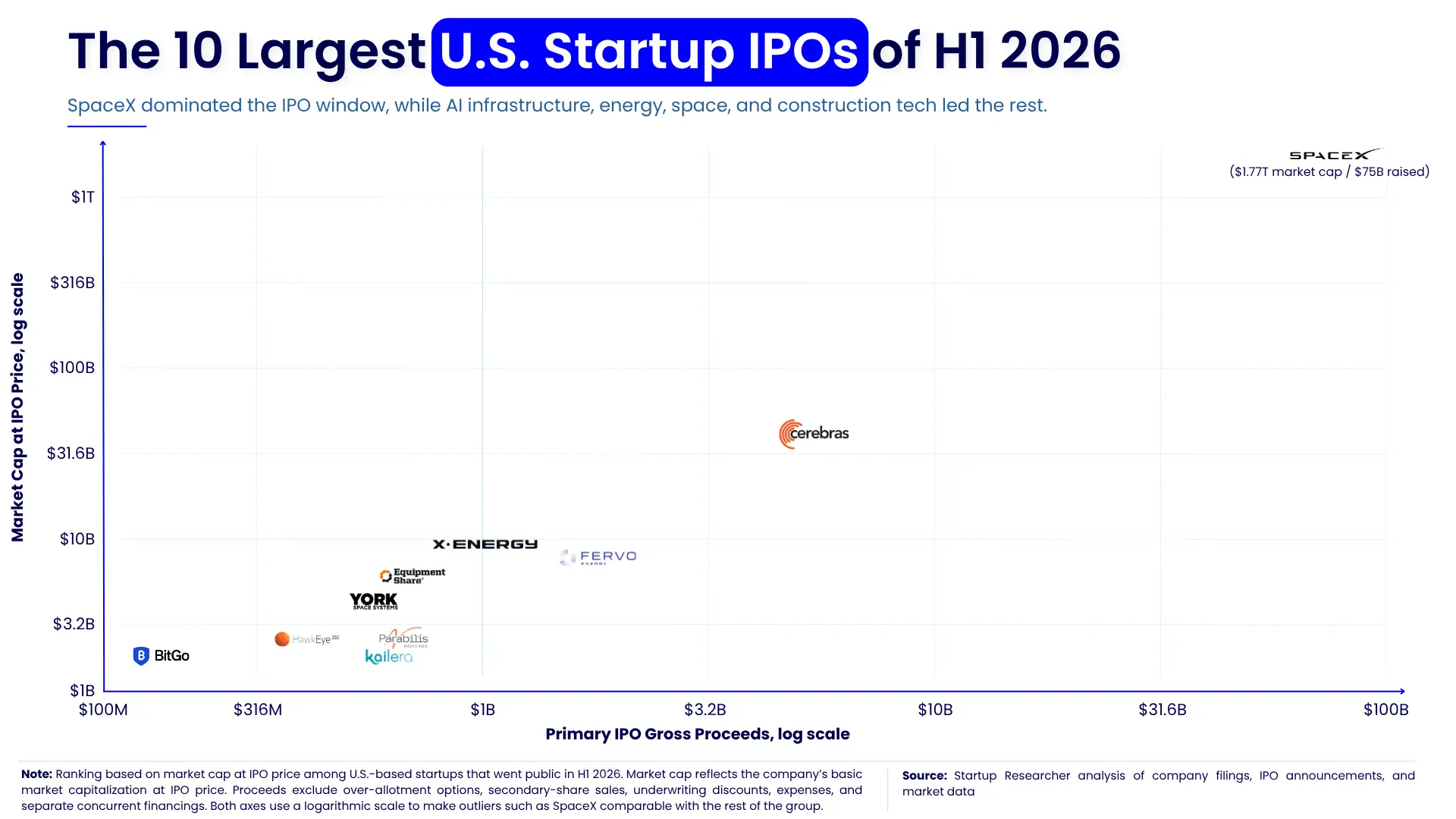
Beyond SpaceX, the largest offerings came from Cerebras Systems, Fervo Energy, X-Energy, EquipmentShare, Parabilis Medicines, York Space Systems, Kailera Therapeutics, HawkEye 360, Generate Biomedicines, and Kardigan. The pattern points to a selective but open public-market window for companies tied to strategic infrastructure, energy security, AI compute, defense, space, and life sciences.
Methodology
This list tracks U.S.-based startups that reached public markets in H1 2026.
Valuation at IPO refers to basic market capitalization at the IPO price, based on the company’s final IPO price and basic share count at listing. Money raised refers only to primary gross proceeds from shares sold by the company in the base offering.
The figures exclude over-allotment options, underwriting discounts, offering expenses, secondary-share proceeds, and separate concurrent financings. The list is based on publicly available company announcements, stock-market data pages, regulatory filings, and financial media reports.
Startups That Went Public in H1 2026
SpaceX
Ticker: SPCX | Exchange: Nasdaq | Sector: SpaceTech | Market Cap at IPO Price: US$1.77 trillion | Primary Gross Proceeds: US$75.00 billion
SpaceX was the defining IPO of H1 2026 and the clear outlier in the dataset. The company’s public debut gave investors exposure to a space infrastructure business built around reusable launch systems, spacecraft, satellite connectivity, and Starlink’s global broadband network. The size of the transaction also distorted the entire period’s IPO totals, making it necessary to view the market both with and without SpaceX.
Cerebras Systems
Ticker: CBRS | Exchange: Nasdaq | Sector: Semiconductors, Electronics & Hardware | Market Cap at IPO Price: US$41.91 billion | Primary Gross Proceeds: US$5.55 billion
Cerebras Systems was the largest non-SpaceX offering of the period and one of the clearest public-market bets on AI infrastructure. The company is known for its Wafer-Scale Engine, a chip architecture designed for ultra-fast AI workloads and promoted as materially larger than GPU-based alternatives. Its IPO gave public investors a pure-play route into AI compute beyond the dominant GPU ecosystem.
X-Energy
Ticker: XE | Exchange: Nasdaq | Sector: Energy & Grid | Market Cap at IPO Price: US$9.35 billion | Primary Gross Proceeds: US$1.018 billion
X-Energy brought advanced nuclear to the IPO market at a time when electricity demand from data centers, industrial users, and grid operators was rising sharply. The company is developing advanced small modular reactors and TRISO-X fuel, positioning itself around clean, scalable, always-on power rather than intermittent generation. Its listing reflected the growing public-market appetite for energy technologies that can support electrification and AI-driven load growth.
Fervo Energy
Ticker: FRVO | Exchange: Nasdaq | Sector: Energy & Grid | Market Cap at IPO Price: US$7.66 billion | Primary Gross Proceeds: US$1.89 billion
Fervo Energy was one of the strongest clean-power listings of the period. The company is trying to make enhanced geothermal scalable by applying oil and gas techniques such as horizontal drilling and distributed fiber-optic sensing to unlock geothermal resources in locations that were previously uneconomic. Its IPO stood out because it gave investors exposure to a firm, 24/7 carbon-free power model at a time when reliability has become as important as decarbonization.
EquipmentShare
Ticker: EQPT | Exchange: Nasdaq | Sector: Real Estate & Construction | Market Cap at IPO Price: US$6.18 billion | Primary Gross Proceeds: US$747.3 million
EquipmentShare was not a pure software IPO, but its positioning went beyond traditional equipment rental. The company combines a national equipment rental footprint with its T3 platform, which gives contractors visibility into machines, maintenance, jobsite activity, and fleet performance. Its listing showed public-market interest in construction technology businesses that pair physical infrastructure with proprietary data and operating software.
York Space Systems
Ticker: YSS | Exchange: NYSE | Sector: SpaceTech | Market Cap at IPO Price: US$4.41 billion | Primary Gross Proceeds: US$629 million
York Space Systems gave public investors exposure to satellite manufacturing and space mission infrastructure rather than launch alone. The company designs spacecraft platforms, manages mission operations, supports constellation deployment, and provides ground-service capabilities for government and commercial customers. Its IPO fit the broader shift in space investment toward defense resilience, satellite networks, and end-to-end mission support.
HawkEye 360
Ticker: HAWK | Exchange: NYSE | Sector: SpaceTech | Market Cap at IPO Price: US$2.42 billion | Primary Gross Proceeds: US$416 million
HawkEye 360 brought space-based radio-frequency intelligence to public markets. The company uses satellites to detect, geolocate, and characterize RF signals, serving defense, intelligence, national-security, maritime, spectrum-monitoring, and GNSS-interference missions. The listing reflected investor demand for dual-use space companies with government-backed revenue potential and direct relevance to geopolitical security priorities.
Parabilis Medicines
Ticker: PBLS | Exchange: Nasdaq | Sector: Biotech & Pharma | Market Cap at IPO Price: US$2.55 billion | Primary Gross Proceeds: US$670 million
Parabilis Medicines was one of the largest biotech IPOs of the period. The company is developing cancer medicines using Helicons, a class of stabilized helical peptides designed to target and modulate proteins that conventional drug modalities have struggled to reach. Its large offering reflected public-market appetite for platform biotechs that combine a clear oncology focus with a differentiated modality.
BitGo
Ticker: BTGO | Exchange: NYSE | Sector: Web3 & Blockchain | Market Cap at IPO Price: US$2.09 billion | Primary Gross Proceeds: US$198.5 million
BitGo’s IPO marked one of the clearest digital-asset infrastructure listings of H1 2026. The company provides custody, wallets, trading, financing, settlement, staking, stablecoin infrastructure, and crypto-as-a-service tools for institutions, enterprises, protocols, and financial platforms. Unlike speculative token-linked listings, BitGo’s public-market story was built around regulated infrastructure for institutional digital-asset activity.
Kailera Therapeutics
Ticker: KLRA | Exchange: Nasdaq | Sector: Biotech & Pharma | Market Cap at IPO Price: US$2.07 billion | Primary Gross Proceeds: US$625 million
Kailera Therapeutics entered the public markets as a focused obesity-care biotech. The company is developing a clinical-stage pipeline built around GLP-1-based mechanisms and multiple routes of administration, including ribupatide, its lead injectable GLP-1/GIP receptor agonist. The IPO tapped into one of the strongest pharmaceutical themes of the period: investor demand for next-generation obesity and metabolic-disease treatments beyond the first wave of GLP-1 leaders.
Generate Biomedicines
Ticker: GENB | Exchange: Nasdaq | Sector: Biotech & Pharma | Market Cap at IPO Price: US$2.05 billion | Primary Gross Proceeds: US$400 million
Generate Biomedicines brought another AI-linked biotech platform to public markets. The company applies machine learning and generative biology to design and optimize protein therapeutics across areas such as immunology, oncology, and respiratory disease. Its IPO showed that investors were still willing to fund computational biology platforms, but with more scrutiny on whether AI-driven discovery can translate into clinical-stage assets and commercial medicines.
Kardigan
Ticker: KARD | Exchange: Nasdaq | Sector: Biotech & Pharma | Market Cap at IPO Price: US$1.43 billion | Primary Gross Proceeds: US$400 million
Kardigan stood out because it came to market with late-stage cardiovascular programs rather than an early discovery platform. The company is advancing precision medicines for cardiovascular diseases, including danicamtiv, ataciguat, and tonlamarsen. Its IPO reflected a more disciplined biotech window where investors favored companies with mature clinical pipelines, near-term data catalysts, and experienced leadership.
Ethos Technologies
Ticker: LIFE | Exchange: Nasdaq | Sector: Insurtech | Market Cap at IPO Price: US$1.20 billion | Primary Gross Proceeds: US$97.4 million
Ethos Technologies brought a profitable life-insurance technology platform to Nasdaq. The company works with carriers to offer life insurance through a digital platform, using technology to simplify distribution, underwriting, and policy activation. Its IPO was also part of a broader insurance listing wave, with investors showing renewed interest in asset-light platforms with revenue growth and profitability rather than pure growth-at-all-costs fintech models.
Alamar Biosciences
Ticker: ALMR | Exchange: Nasdaq | Sector: Biotech & Pharma | Market Cap at IPO Price: US$1.18 billion | Primary Gross Proceeds: US$191.3 million
Alamar Biosciences entered public markets as a commercial-stage precision proteomics company. Its NULISA platform is designed to detect low-abundance protein biomarkers with high sensitivity, supporting research across neurology, immunology, oncology, and other disease areas. The IPO gave investors exposure to the tools layer of biotech, where platform adoption can be driven by research demand rather than a single drug candidate.
Eikon Therapeutics
Ticker: EIKN | Exchange: Nasdaq | Sector: Biotech & Pharma | Market Cap at IPO Price: US$974.5 million | Primary Gross Proceeds: US$381.2 million
Eikon Therapeutics was one of the more closely watched oncology IPOs of H1 2026. The company was founded around single-molecule imaging technology and is developing cancer medicines, with its lead candidate being studied in combination with Merck’s Keytruda. Its IPO mattered because it combined a high-profile scientific origin story, experienced leadership, and a late-stage oncology program in a market still selective toward platform-heavy biotechs.
Deep Fission
Ticker: FISN | Exchange: Nasdaq | Sector: Energy & Grid | Market Cap at IPO Price: US$965.3 million | Primary Gross Proceeds: US$40 million
Deep Fission was a smaller offering, but it added another advanced nuclear name to the H1 2026 IPO cohort. The company is developing small modular pressurized-water reactors designed for underground installation, positioning itself around security, land-use, and infrastructure advantages. Its listing showed how even earlier-stage nuclear concepts were finding public-market attention as energy demand from AI, industrial electrification, and grid reliability became more urgent.
Seaport Therapeutics
Ticker: SPTX | Exchange: Nasdaq | Sector: Biotech & Pharma | Market Cap at IPO Price: US$963.5 million | Primary Gross Proceeds: US$254.9 million
Seaport Therapeutics gave investors exposure to neuropsychiatric drug development, an area that has historically been difficult but remains commercially large. The company is developing oral therapies for depression, anxiety, and other neuropsychiatric disorders through its Glyph platform, which is designed to improve the delivery and tolerability of medicines affected by first-pass metabolism, low bioavailability, or side-effect limitations. Its IPO fit the broader biotech theme of investors backing platform companies only when they are tied to defined clinical programs.
Aktis Oncology
Ticker: AKTS | Exchange: Nasdaq | Sector: Biotech & Pharma | Market Cap at IPO Price: US$945.4 million | Primary Gross Proceeds: US$317.7 million
Aktis Oncology opened the year’s U.S. biotech IPO activity with a targeted radiopharmaceuticals story. The company is developing tumor-targeting radiopharmaceuticals for solid tumors, with Eli Lilly participating as an anchor investor through a large IPO commitment. That strategic backing mattered because radiopharmaceuticals have become one of the most active areas in oncology, attracting both public investors and large pharmaceutical partners.
Odyssey Therapeutics
Ticker: ODTX | Exchange: Nasdaq | Sector: Biotech & Pharma | Market Cap at IPO Price: US$861.8 million | Primary Gross Proceeds: US$279 million
Odyssey Therapeutics came to market with a focus on autoimmune and inflammatory diseases. Its lead candidate, OD-001, is being evaluated in mid-stage trials for ulcerative colitis, giving the company a defined clinical story rather than only a discovery platform. The IPO also benefited from the track record of founder and CEO Gary D. Glick, who previously founded Scorpion Therapeutics, later acquired by Eli Lilly.
Hemab Therapeutics
Ticker: COAG | Exchange: Nasdaq | Sector: Biotech & Pharma | Market Cap at IPO Price: US$840.8 million | Primary Gross Proceeds: US$301.5 million
Hemab Therapeutics brought a rare-disease hematology focus to the IPO market. The company is developing targeted therapies for serious bleeding and coagulation disorders, including Glanzmann thrombasthenia, von Willebrand disease, and Factor VII deficiency. Its public-market story centered on prevention-focused therapies for conditions where treatment options remain limited and where specialized pipelines can support orphan-disease commercial models.
Avalyn Pharma
Ticker: AVLN | Exchange: Nasdaq | Sector: Biotech & Pharma | Market Cap at IPO Price: US$797.9 million | Primary Gross Proceeds: US$300 million
Avalyn Pharma raised capital around a targeted inhaled-therapy strategy for rare respiratory diseases. The company is developing inhaled formulations for pulmonary fibrosis and other interstitial lung diseases, including AP01, AP02, and AP03. The core logic of the company is to deliver medicines directly to lung tissue, potentially improving efficacy while reducing systemic side effects associated with oral delivery.
Once Upon a Farm
Ticker: OFRM | Exchange: NYSE | Sector: FoodTech & Food & Beverage | Market Cap at IPO Price: US$724.2 million | Primary Gross Proceeds: US$137.4 million
Once Upon a Farm was one of the clearest consumer-brand listings in the H1 2026 cohort. The company sells organic food products for babies, toddlers, and children, including cold-pressed pouches, oat bars, and frozen meals, and has built its brand around childhood nutrition and clean ingredients. Its IPO showed that public markets were still open to differentiated consumer brands, but only where revenue growth, distribution expansion, and brand equity were strong enough to stand out.
Veradermics
Ticker: MANE | Exchange: NYSE | Sector: Biotech & Pharma | Market Cap at IPO Price: US$710.3 million | Primary Gross Proceeds: US$256.3 million
Veradermics brought a dermatology-focused biotech story to the NYSE. The company is developing VDPHL01, a non-hormonal oral treatment for pattern hair loss in men and women, supported by large placebo-controlled clinical trials. Its IPO drew attention because pattern hair loss is a large, emotionally significant market where the standard of care has seen limited innovation for decades.
SpyGlass Pharma
Ticker: SGP | Exchange: Nasdaq | Sector: MedTech | Market Cap at IPO Price: US$534.9 million | Primary Gross Proceeds: US$150 million
SpyGlass Pharma entered public markets with a device-enabled drug delivery model for chronic eye disease. Its BIM-IOL System is designed to combine cataract surgery with sustained bimatoprost delivery, targeting patients with glaucoma or ocular hypertension who need long-term intraocular pressure reduction. The company’s IPO sat at the intersection of ophthalmology, medtech, and sustained drug delivery.
Mobia Medical
Ticker: MOBI | Exchange: Nasdaq | Sector: MedTech | Market Cap at IPO Price: US$498.8 million | Primary Gross Proceeds: US$150 million
Mobia Medical gave public investors exposure to neurostimulation-assisted stroke rehabilitation. The company markets Vivistim Paired VNS Therapy, an FDA-approved system that pairs vagus nerve stimulation with rehabilitation to improve upper-extremity motor function in chronic ischemic stroke survivors. Its IPO reflected the growing role of device-enabled rehabilitation technologies in addressing long-term neurological disability.
Rank One Computing
Ticker: ROC | Exchange: Nasdaq | Sector: Defense, Security & Public Safety | Market Cap at IPO Price: US$114.5 million | Primary Gross Proceeds: US$24 million
Rank One Computing, now branded as ROC, brought Vision AI and biometrics software to the public market. The company’s platform combines multimodal biometrics, video analytics, identity verification, and mission intelligence for defense, public safety, physical security, and digital identity use cases. Its IPO reflected investor interest in smaller defense and public-safety software providers operating at the edge of AI, security, and identity infrastructure.
Buda Juice
Ticker: BUDA | Exchange: NYSE American | Sector: FoodTech & Food & Beverage | Market Cap at IPO Price: US$94.3 million | Primary Gross Proceeds: US$20 million
Buda Juice was one of the smallest listings in the group, but it added a niche consumer-food angle to the H1 2026 IPO market. The company positions itself around cold-crafted, Ultra Fresh juices and wellness-oriented beverages. Its IPO was less about category-defining scale and more about whether a small premium beverage brand could use public capital to expand distribution and visibility.
Swarmer
Ticker: SWMR | Exchange: Nasdaq | Sector: Defense, Security & Public Safety | Market Cap at IPO Price: US$61.5 million | Primary Gross Proceeds: US$15 million
Swarmer was a small IPO, but it sat in one of the most strategically relevant defense technology themes: collaborative autonomy. The company develops software for autonomous navigation, AI-driven collaboration, real-time combat data, and scalable unmanned-system coordination. Its public-market story was shaped by the rapid evolution of drone warfare and the increasing importance of software that allows smaller teams to coordinate larger numbers of unmanned systems.
Exyn Technologies
Ticker: EXYN | Exchange: Nasdaq | Sector: Aerospace, Aviation & Drones | Market Cap at IPO Price: US$59.7 million | Primary Gross Proceeds: US$19.4 million
Exyn Technologies brought autonomous robotic mapping and GPS-denied navigation to the public markets. The company develops autonomy, localization, and 3D mapping software and hardware for complex environments such as mining, construction, geospatial, oil and gas, and defense. Its IPO represented a small but relevant industrial autonomy listing, focused on places where robots need to operate without reliable GPS or safe human access.
Vida Global
Ticker: VIDA | Exchange: NYSE American / NYSE Texas | Sector: AI, Data & Infrastructure | Market Cap at IPO Price: US$57.1 million | Primary Gross Proceeds: US$15 million
Vida Global was the smallest company in the group by market cap at IPO price, but it reflected the broader public-market appetite for AI infrastructure and workflow automation. The company develops a cloud-based AI Agent Operating System that helps enterprises and channel partners deploy, govern, manage, and scale agents across voice, messaging, email, and web workflows. Its IPO was a small-cap expression of the same AI adoption theme that supported larger infrastructure listings during the period.
The H1 2026 U.S. startup IPO landscape was broad by sector but narrow in capital concentration. Biotech and pharma produced 12 of the 30 listings and raised US$4.377 billion in primary gross proceeds, showing that public investors were still willing to fund clinical-stage companies with differentiated platforms and advanced pipelines.
The headline figures, however, are dominated by SpaceX. Its US$75 billion raise and US$1.77 trillion basic market cap at IPO price heavily skewed the period. Without SpaceX, the market looked less like a full reopening and more like a selective window for companies tied to strategic technologies, infrastructure, energy, defense, space, and life sciences.
Across the full list, 22 of the 30 startups raised less than US$500 million. That makes H1 2026 less a broad-based return of the IPO market and more a targeted public-market opening for companies with clear scale, strategic relevance, or sector-specific investor demand.